
Pool School, Shock
Pool shock: what it is, when to do it, and which one to use
Shock oxidizes what your sanitizer cannot: sweat, sunscreen, oils and the used-up chlorine compounds that make a pool smell. Do it weekly in swim season, after a party, a storm or a heat wave, and any time combined chlorine reads 0.5 ppm or free chlorine reads zero. One pound per 10,000 gallons is the routine dose for every granular shock we sell.
What does pool shock actually do?
Shock means oxidizing the contaminants out of your water: sweat, sunscreen, body oils, leaves, pollen, and the used-up chlorine compounds (chloramines) that build up as your sanitizer does its job. There are two ways to do that.
- Chlorine shock raises free chlorine well above its normal 1 to 3 ppm range, typically to about 10 ppm, so it burns through the contaminants and the chloramines all at once. When free chlorine comes back down, the water is reset.
- Non-chlorine shock (potassium monopersulfate, or MPS) uses active oxygen to oxidize contaminants without raising the chlorine level at all. It clears dull, cloudy water fast and lets you get back in the pool in minutes. It is not a sanitizer and does not kill algae. It works alongside your chlorine or salt system, not instead of it.
When should I shock? The test kit answer
Your test kit gives you two chlorine numbers. Free chlorine (FC) is the active chlorine available to sanitize. Total chlorine (TC) is free chlorine plus the chlorine that has already combined with contaminants. The difference is combined chlorine (CC = TC minus FC). In a clean pool FC and TC read the same and CC is zero.
When total chlorine reads higher than free chlorine, you have chloramines. That is the chemical signal to shock. The industry standard is to shock when combined chlorine reaches 0.5 ppm; many pros act at 0.2. Chloramines are what cause the sharp chlorine smell and stinging eyes. A well kept pool barely smells of chlorine at all.
Two other test kit triggers:
- Free chlorine at zero. If FC has been used up, contaminants are winning and you need to reset.
- Ugly water with normal readings. Dull, hazy or greenish water that will not clear with the pump running usually means you need to oxidize.
To fully clear chloramines you need breakpoint chlorination, roughly 10 times your combined chlorine reading. If CC is 0.5 ppm you need about 5 ppm of free chlorine above where you are; if CC is 1.0 ppm, about 10 ppm. That is why a standard shock dose targets about 10 ppm. If your stabilizer (cyanuric acid) is high you will need a higher target, and if you are shocking to kill an algae bloom, follow the algae directions on the bag rather than the routine dose.
When should I shock? The practical answer
You do not need to test every day to know when to shock. Shock after anything that dumps organic load into the water or knocks out your chlorine:
- Heavy swimming. A pool party, a weekend with family in town, kids in and out all day. By Saturday evening the water looks dull because the chlorine has been used up.
- Rain, wind or leaf drop. Storms bring in debris, pollen and dirt, and dilute your chemistry.
- A stretch of hot, sunny days. Sun and heat burn through chlorine faster.
- Opening and closing for the season.
- After an algae problem, or any time the water looks cloudy, dull or green.
- Strong chlorine smell or stinging eyes. That is chloramines, not too much chlorine.
Once a week during swim season is the right default. Weekly shock is cheap insurance: an algae bloom or a cloudy water fix costs far more in chemicals and time than a weekly bag of shock. But every pool has its own personality. A busy, uncovered pool in July with rain, leaves and kids swimming every day needs it weekly. A covered pool with nobody swimming, no rain and little sun can go a few weeks. Once you know your pool, you will know.
Which shock should I use?
Four kinds, and each one is right for somebody. The table is the short version; the sections under it are the long one.
| Cal hypo 68% | Dichlor | Non-chlorine (MPS) | E-Z POOL weekly | |
|---|---|---|---|---|
| Routine dose | 1 lb per 10,000 gal | 1 lb per 10,000 gal | 1 lb per 10,000 gal | 2 to 3 scoops (1 to 1.5 lb) per 10,000 gal, from the label chart |
| Green pool dose | 2 to 3 lb per 10,000 gal, per label | 2 to 3 lb per 10,000 gal, per label | Not a sanitizer | Chlorine shock first, then resume |
| How to add | Pre-dissolve for vinyl; can cloud briefly | Broadcast; dissolves fast | Broadcast; dissolves instantly | Broadcast weekly |
| Swim wait | Until free chlorine tests 1 to 3 ppm, often overnight | Sooner than cal hypo, per label | 15 minutes | 15 minutes |
| Effect on pH | Raises | Slightly lowers | Slightly lowers | Buffers |
| Adds to the water | Calcium | Stabilizer (CYA) | Sulfates | Balancers, copper |
| Salt pool | In moderation; calcium scales the cell | Good | Best | Compatible |
| Vinyl or above-ground | Pre-dissolve | Best | Good | Compatible |
| Kills algae | Yes (registered) | Yes (registered) | No, oxidizer only | Yes, copper algaecide, per label |
| Best for | Lowest cost, green pool rescue, plaster pools | Weekly shock on vinyl and above-ground, bulk buyers | Swim now, salt pools, heavy use, spas | One scoop a week owners |
| We carry | Shockwave 68% and Super Shockwave 73%, 1 lb bags and cases | Pool Season Di-Chlor, 1 lb bags, 2, 25 and 50 lb | Pool Season Non-Chlorine Shock, 1 lb bags and cases | E-Z POOL 5, 10 and 20 lb |
Calcium hypochlorite (cal hypo): the lowest cost per dose
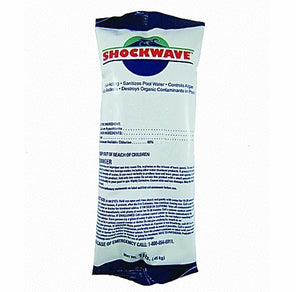
Cal hypo is the most economical way to shock and the workhorse of the industry, a granular product sold by the pound. We carry Shockwave 68% and Super Shockwave 73%. Both are full-strength products: 68% calcium hypochlorite with 65% available chlorine, and 73% with 70%. The 73% has a little more chlorine and a little less inert material per pound, so a bag goes slightly further and leaves slightly less calcium behind. Once you are in the 70s you are at the ceiling; there is no meaningful jump from 73% to 75%. Avoid the cheap 40 to 50% shock sold in big-box stores. It is padded with inert filler, so you need far more of it to reach the same chlorine level, and it leaves the pool cloudy.
- Dose: 1 lb per 10,000 gallons for a routine shock. One 1 lb bag raises 10,000 gallons by roughly 7 to 8 ppm of free chlorine.
- Downsides: it adds calcium to the water, and the water can be hazy for a few hours while the granules dissolve. Undissolved granules on the floor can bleach vinyl and are miserable if you get one in your eye. Add it with the pump running, brush if needed, and stay out until it has dissolved and the chlorine has come down.
- Swim wait: plan on overnight to 24 hours. The label rule is to wait until free chlorine tests back to a safe level, typically 4 ppm or below. Test before you swim.
- Bags beat buckets. Scooping from a bucket gets cal hypo dust on your hands (two hours of chlorine smell) and it bleaches clothes on contact. Pre-measured 1 lb bags are cleaner and easier to dose.
- Safety: never mix cal hypo with trichlor tablets or any other chemical, and always add chemical to water, never water to chemical.
Dichlor: chlorine shock for vinyl and above-ground pools
Sodium dichlor is 99% dichlor, 56% available chlorine. It dissolves fast, will not bleach a liner, and sits near neutral pH, which is why it is the chlorine shock we recommend for vinyl and above-ground pools and the one in the Pool Season line. The catch: every pound adds about 6 ppm of stabilizer per 10,000 gallons. If you shock with dichlor every week, test cyanuric acid monthly and switch part of your shocking to non-chlorine or cal hypo when it climbs past 80.
- Dose: 1 lb per 10,000 gallons; 2 to 3 lb per 10,000 for green water, per the label.
- Sizes: 1 lb bags singly and in cases of 6 and 12, and 2, 25 and 50 lb buckets. The buckets are the price leader per pound.
- Swim wait: when free chlorine tests back in range. Sooner than cal hypo, because there is nothing left to dissolve.
Liquid chlorine (sodium hypochlorite)
Popular in many markets and a good shock when you use it fresh. Pool grade is 10 to 12.5% sodium hypochlorite; household bleach is much weaker, often has additives, and is not a substitute. One gallon of 12.5% raises 10,000 gallons by about 12.5 ppm. It dissolves instantly, adds no calcium and leaves nothing on the floor. It also loses strength as it sits, and heat speeds that up: at 77°F it loses about half its strength in roughly six months, and in a hot shed in summer in about seven weeks. Buy what you will use in the next few weeks. It raises pH slightly and, with repeated use, adds dissolved solids. It is a freight item, so we do not ship it. Pool Shock lists it when it is in stock for pickup.
Non-chlorine shock (MPS): swim again in 15 minutes
Non-chlorine shock uses potassium monopersulfate, active oxygen, to oxidize contaminants without adding chlorine. Pool Season Non-Chlorine Shock is 42.8% potassium peroxymonosulfate.
- Best for: busy swim weekends. Family is in town, everyone swims all day Saturday, and by evening the water looks dull. You do not want to dump in chlorine shock and lock the pool down for 24 hours. Non-chlorine shock clears that water fast.
- Swim wait: 15 minutes after the product has dissolved, per the Pool Season label.
- Dose: 1 lb per 10,000 gallons.
- What it does not do: sanitize, or kill algae. Keep your tablets or salt cell running and use MPS as the oxidizer. It leaves your chlorine residual right where it was.
- Testing note: MPS interferes with DPD test kits. For a day or so after dosing it can read as a false combined chlorine. Add it in the evening and test the next morning, or use a kit with a monopersulfate interference remover, before deciding you need to chlorine shock.
- Cost: more per dose than cal hypo or dichlor, which is why most owners keep a few bags on hand for weekends rather than using it as their only shock.
The all-in-one option: E-Z POOL
E-Z POOL by APi Water Care is a once-a-week concentrated blend: a stable oxygen-based oxidizer, a maintenance dose of copper-based mineral algaecide, a clarifier, a scale inhibitor and water balancers for pH, alkalinity and calcium hardness, in one scoop. You keep your normal sanitizer (tablets, salt, bromine or mineral) and add E-Z POOL once a week. APi's position is that once your pool is balanced on the program you do not need a separate weekly shock.
- Dose: once a week by the label chart, from 2 scoops for a 15 or 18 ft round pool to 6 for a 20 x 40, about 2 to 3 scoops per 10,000 gallons. The 5, 10 and 20 lb pails each carry an 8 oz scoop, which is half a pound, filled to the line. Opening and clean-up doses are on the pail.
- Compatible with chlorine, salt, bromine, UV and ozone systems; vinyl, fiberglass, plaster and pebble surfaces.
- Who it is for: the owner who wants the pool to look great without thinking about it. It costs more per week than cal hypo, and it replaces the shock, the algaecide and most of the balancers you would otherwise buy separately.
- Still shock with chlorine for an active bloom. E-Z POOL is prevention, not a cure. If you have visible algae, brush, shock with chlorine, wait 24 hours, then resume the program.
- Swim wait: 15 minutes after adding it to a circulating pool, per APi, and an automatic cover can close at the same point.
- Pair it with Revive! at start-up and as a periodic clean-up for phosphates and metals.
What about salt pools?
A salt chlorine generator makes your chlorine, but it does not oxidize the water the way a shock does. Salt pools still need to be shocked, weekly or every other week.
- Cal hypo adds calcium. Every routine dose adds roughly 5 to 7 ppm of calcium hardness. Over a season that adds up, and high calcium is the main cause of scale on the cell plates, which shortens cell life. If you shock a salt pool with cal hypo, watch calcium hardness.
- Dichlor is a good fit: no calcium, near neutral pH. Watch the stabilizer.
- Non-chlorine shock is the gentlest option for the cell: no calcium, no extra chlorine, swim in 15 minutes. E-Z POOL is compatible with salt systems as well.
- Most salt systems have a boost or super chlorinate mode that raises output for 24 hours. It is fine for light maintenance. It will not replace a real shock after a party or a storm.
Which shock should you buy?
- "I just want it easy." E-Z POOL once a week. Follow the directions and the pool stays clear.
- "I am hands-on and want to save money." Shockwave 68% as your weekly shock, with a few bags of Pool Season Non-Chlorine Shock in the shed for busy weekends so you never have to lock the pool down.
- "I want it clear and fast." Super Shockwave 73%: the same routine dose, finer and faster dissolving, a little more chlorine per bag.
- "I have a vinyl or above-ground pool." Pool Season Di-Chlor. Fast dissolving, liner safe.
- "I have a salt pool." Non-Chlorine Shock or Di-Chlor for routine shocks. Watch calcium if you use cal hypo.
- "We are swimming again in an hour." Non-Chlorine Shock.
- "The pool is green." Shockwave 68% at 2 to 3 lb per 10,000 gallons, brush, run the filter around the clock, and repeat until it holds chlorine. Then Polyquat 60 and a clarifier once it clears.
Products in this guide


Questions about pool shock
How much shock do I need for my pool?
One pound of granular shock per 10,000 gallons is the routine dose for cal hypo, dichlor and non-chlorine shock alike. A 20,000 gallon pool takes two 1 lb bags. For green water, 2 to 3 pounds per 10,000 gallons of a chlorine shock, per the label, repeated until the water holds chlorine overnight.
How long after shocking can I swim?
After non-chlorine shock, 15 minutes once it has dissolved. After chlorine shock, when free chlorine tests back at a safe level, typically 4 ppm or below and ideally 1 to 3. That is usually overnight for cal hypo and the same evening or next morning for dichlor with the pump running. Test first.
Why is my pool cloudy after shocking?
Cal hypo leaves the water hazy for a few hours while the granules dissolve and the filter catches the calcium. Run the pump, brush anything on the floor and give it a day. If it stays cloudy with chlorine in range, it is a filtration or balance problem, not a chlorine problem: check the filter, then pH and alkalinity, then use a clarifier.
Can I use cal hypo in a salt or vinyl pool?
Yes, with care. In a salt pool it adds calcium that scales the cell, so watch hardness or shock with dichlor or non-chlorine instead. On vinyl, pre-dissolve it in a bucket of water so no granule sits on the liner.
What is the difference between chlorine tablets and shock?
Tablets are the sanitizer: slow, stabilized trichlor that holds a steady 1 to 3 ppm all week. Shock is the reset: a fast, large dose that burns off what the tablets cannot keep up with. You need both. Tablets alone let contaminants accumulate; shock alone leaves the pool unprotected between doses.