

Pentair
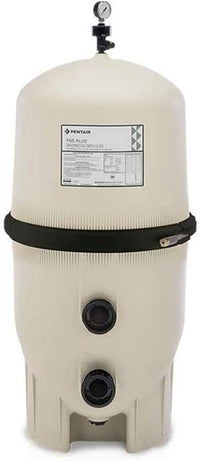
Pentair Triton II TR100 30" Side Mount Sand In-Ground Pool Filter, EC-140210MPN EC-140210
$1,54900
In stock

New customer? Create an account
Sign in to track an order, view past orders, start a return, and save the equipment you own so every part you see already fits it.
Three kinds of filter and they are not interchangeable choices. Sand is the cheapest to own and the coarsest, and you clean it by backwashing. Cartridge catches finer dirt, wastes no water because there is nothing to backwash, and asks you to pull the element out and hose it. DE is the finest of the three and the most work, because the powder has to be recharged after every clean. Check the valve too: on this shelf some filters include a multiport and some do not.


Sand filters, cartridge filters and DE filters from Pentair, Hayward, Waterway, Waterco and Astral, in top mount and vertical grid designs, with filter areas from 48 up to 200 sq ft and flow rates past 150 GPM on the commercial bodies. Tanks are mostly fibreglass reinforced thermoplastic.
Cartridges, grids, laterals, o-rings and multiport valves are in filter parts, and the cartridge elements themselves have their own page at filter cartridges.
Sand, cartridge or DE?
Trade filtration fineness against how much work you want to do. Sand is the least fussy and the most forgiving of neglect, and you clean it by reversing the flow for a couple of minutes, which costs a tank of water each time. Cartridge filters finer, uses no water to clean, and needs the element pulled and hosed a few times a season. DE gives the clearest water of the three by some margin and is the most involved, because the powder washes out with the dirt and has to be recharged through the skimmer afterwards.
Does the filter come with a valve?
Not always, and it is the commonest surprise on this page. A sand or DE filter needs a multiport valve to select filter, backwash, rinse and waste, and on our shelf some products include one and several say outright that it is not included. Cartridge filters generally need no multiport at all, which is one of the quiet reasons they are simpler. Read the valve line on the product before ordering, because a filter with no valve is not a working filter and the valve is not a trivial part.
What does the square footage mean?
It is the area of media the water passes through, and more of it is genuinely better. A larger filter does not clean to a finer standard, it holds more dirt before the pressure climbs, which means longer between cleans, lower resistance for the pump to work against, and a longer life out of the element. Areas here run from 48 up to 200 sq ft. Oversizing a filter has no downside beyond the space it takes and what it costs, which is the opposite of oversizing a pump.
How do I know it needs cleaning?
Watch the pressure gauge rather than the calendar. Note what the gauge reads with a clean filter and a clean pump basket, because that is your baseline and it differs on every pool. When it climbs eight to ten psi above that, flow has fallen enough to matter and it is time. Cleaning before that achieves little, and a filter works slightly better a bit dirty. If the pressure comes straight back up after a clean, the media is due for replacement rather than the element being dirty.