
Pool School, Heaters
Pool Heat Pump vs Gas Heater
Active Pool Supply · Updated September 29, 2026
Buy a heat pump to hold a pool at a set temperature through a mild season, and a gas heater to heat on demand: a weekend, a spa, a cold snap. Gas is the fast one, at 82 to 84 percent thermal efficiency on most models. A heat pump delivers 4 to 6 times the electricity it draws, by AHRI's figure, but five manufacturers' models give 36 to 39 percent less heat at their 50F air rating than at 80F. Electric can also mean a resistance heater, a third machine: 100 percent efficient, so it draws about five times the power of a heat pump for the same heat.
Which one to buy, as a rule you can apply
Choose by how you use the pool, not by the fuel.
- Heat pump: you hold the water at one temperature for weeks at a time, in mild air. AHRI says a heat pump is at its best maintaining a constant temperature. Pentair adds that one can take days to reheat a cold pool.
- Gas heater: you heat on demand, for a weekend, a spa or a pool opened in cold air. Raypak's chart gives its 399,000 BTU model 3.5F an hour on a 300 square foot pool.
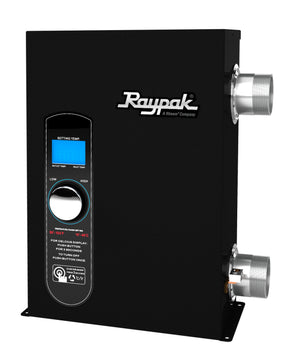
- Electric resistance heater: a spa, or an indoor room where a gas heater cannot be vented, which is Raypak's own positioning.
The Department of Energy states the trade: a heat pump is dearer to buy and typically much cheaper to run.
Electric means two different machines
"Gas vs electric" is two questions, because two unlike machines plug in.
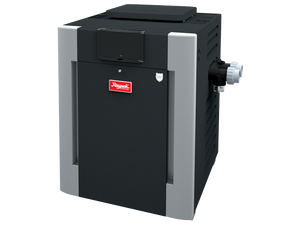
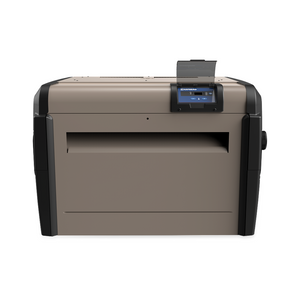
- Gas heater. Burns natural gas or propane and heats the water in a heat exchanger. Raypak's Digital 406A takes in 399,000 BTU an hour and puts 327,180 into the pool.
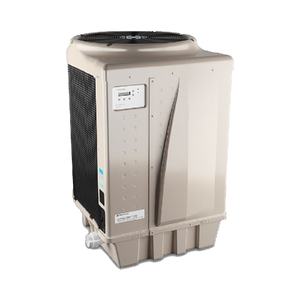
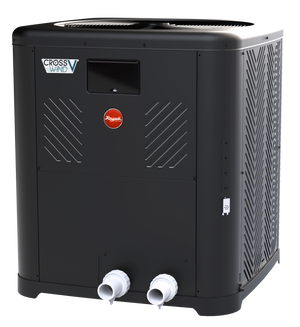
- Heat pump. Burns nothing. It is an air to water machine: a fan, a coil and a compressor take heat from outdoor air and put it in the pool. The electricity moves heat, it does not make it, so more comes out than goes in.
- Electric resistance heater. Current through a titanium element in the water, on Raypak's E3T. A kilowatt in is a kilowatt of heat out. The E3T runs from 5.5 kW, which is 18,767 BTU an hour, to 27 kW and 92,128 BTU on single phase power.
Gas, heat pump and resistance, side by side
| What decides it | Gas heater | Heat pump | Electric resistance heater |
|---|---|---|---|
| How it makes heat | Burns natural gas or propane | Moves heat from outdoor air to the water | Current through an element in the water |
| Speed | Raypak: 1.0F to 3.5F an hour from 399,000 BTU, by pool area | Pentair: about 1F an hour | Raypak: 9F an hour from 11 kW, 500 gallon spa |
| Efficiency measure | Thermal efficiency, 82 to 84 percent on most | COP. AHRI: 4.0 to 6.0. Department of Energy: 3.0 to 7.0 | 100 percent, a COP of 1 |
| In cold air | Rated with no air temperature. Altitude cuts it | 36 to 39 percent less heat at 50F than at 80F | Rated in kW, with no air temperature |
| Needs | A sized gas line, a vent kit indoors | A 208 to 230 volt circuit | 240 volts, 23 to 112.5 amps |
| Best for | Heating on demand, and spas | Holding a set temperature all season | Spas and unvented indoor rooms |
Speed: degrees an hour, by manufacturer
Gas is quicker because it is bigger. Raypak's heat pump manual says so: for the same pool a heat pump has less BTU capacity than a gas heater, and may run 24 hours a day at times.
- Gas, Raypak. The 399,000 BTU Digital lifts 300 square feet of pool 3.5F an hour, 500 square feet 2.1F and 1,000 square feet 1.0F, at 5 ft average depth.
- Heat pump, Pentair. A properly sized unit averages 1F an hour, depending on the air, the humidity and the water.
- Electric resistance, Raypak. Degrees an hour is kW times 410 over gallons, a spa formula. No manufacturer we read publishes the pool equivalent.
For your own pool, borrow Raypak's capacity check: BTU output over gallons times 8.33. On 20,000 gallons the 406A at 327,180 BTU gives 2.0F an hour. Pentair's UltraTemp 140 gives 0.9F at its best rating and 0.5F at its 50F air rating. The arithmetic is ours, and like the check it ignores the weather.
Efficiency: one measure on two scales
A gas heater at 84 and a heat pump at 5.8 measure the same thing, heat out over energy in. One is a percentage, the other a multiple. Pentair prints them on one scale: 0.84 for gas, 1.00 for electric resistance, 5.80 for its heat pump.
Gas is rated by thermal efficiency. Raypak states 82 percent on the Digital line and 84 on the AVIA. Pentair states 84 on the MasterTemp with a copper exchanger and 82 with cupronickel. Hayward's Universal H-Series 400 is 84, and Jandy's JXi 400 is 84.0 or 83.0 by model. Raypak's Professional X94 is 94 and Pentair's ETi 400 is 96.
The federal floor is 82 percent for gas pool heaters made from April 16, 2013 until May 30, 2028. From that date it is a formula on the heater's input, which the Department of Energy says rests on 84 percent.
A heat pump is rated by COP, heat delivered over electricity drawn. A kilowatt hour is 3,413 BTU, so at a COP of 5 each one you pay for puts 17,065 BTU in the pool. The other 13,652 came out of the air. The Department of Energy says COPs usually run 3.0 to 7.0. AHRI's typical range is narrower, 4.0 to 6.0. One machine has three ratings, set out under cold air.
Electric resistance is 100 percent, a COP of 1, in the department's table and Pentair's. For equal heat it draws five times the power of a heat pump at a COP of 5. The 2028 federal rule puts both electric types in one class, with a minimum set by formula. For 11 kW of input we work it out to about 575 percent. Spa heaters of 11 kW or less, made to sit inside a portable spa, are left out.
Running cost: the method, with your own rates
We print no energy prices. They differ by town and go stale.
- Gas. A therm is 100,000 BTU. Divide the input by 100,000 for therms an hour: 399,000 BTU burns 3.99 while it fires. Multiply by your rate per therm.
- Heat pump. Divide the output in BTU by 3,413, then by the COP, for kilowatts. At 145,000 BTU and a COP of 5.8 that is 7.3 kW. Multiply by your rate per kilowatt hour.
- Electric resistance. The rating is the draw: 11 kW.
Then compare on heat delivered, not on cost an hour. To put 100,000 BTU in the water, a gas heater at 84 percent burns 1.19 therms, a heat pump at a COP of 5 draws 5.9 kilowatt hours, and a resistance heater draws 29.3. Price each from your own bills.
The Department of Energy publishes two annual cost tables: the same 13 cities and the same 1,000 square foot outdoor pool, one for an 80 percent gas heater and one for a heat pump averaging a COP of 5.0. Each rests on one energy price with no date. At those prices the heat pump figure is close to half the gas figure in every city. Your rates will move that. AquaCal's brochure says about a quarter and states no basis.
The department's Better Buildings program credits pool covers with saving 50 to 70 percent of heating cost, whichever heater you buy.
Cold air: what a heat pump gives up
A heat pump has no single output. The manufacturers rate each model at three points, citing AHRI Standard 1160: air at 80F and 80 percent humidity, 80F and 63 percent, and 50F and 63 percent, with the water at 80F in all three. Pentair calls the first the rated condition. The federal test, by the Department of Energy's account, uses the second.
| BTU an hour and COP | 80F air, 80 percent humidity | 50F air, 63 percent humidity |
|---|---|---|
| Pentair UltraTemp 140 | 145,000 at 5.8 | 90,000 at 4.0 |
| Raypak Crosswind V 6550 | 118,000 at 6.1 | 75,000 at 4.1 |
| Hayward HP21404TC | 140,000 at 5.7 | 85,000 at 4.0 |
| Jandy JRT3000R | 130,000 at 5.8 | 82,000 at 4.0 |
| AquaCal SQ200R | 138,000 at 6.1 | 88,000 at 4.2 |
The five give up 36 to 39 percent of their heat between those columns. The power drawn barely falls: the Pentair UltraTemp 140 goes from 7.3 kW to 6.6 kW while its output drops by 55,000 BTU.
Check the order before comparing brochures. Raypak writes air, humidity, water, so its cold point reads (50,63,80). AquaCal writes water first, so the same point reads 80/50/63.
There is no single minimum air temperature. What is published:
- Department of Energy: efficient while the outside air stays above 45F to 50F.
- Raypak: the Crosswind V locks out at 45F from the factory, adjustable from 30F to 50F. The 2450 to 8450 models leave the factory with the lockout off.
- Hayward: the HeatPro Low Ambient models list 40F.
- Pentair: no floor for the UltraTemp. It may defrost at around 50F air, and shuts down on a Low Ambient Temp alarm if defrost fails.
- AquaCal: says its ICEBREAKER models keep heating at freezing temperatures.
A gas heater's rating has no air temperature in it. Altitude cuts it: above 2,000 ft Raypak derates the Digital 4 percent per 1,000 ft of elevation, Jandy's JXi holds its rating to 4,500 ft, and Pentair's manuals give no limit.
What each one needs at the equipment pad
Gas heater
- The right fuel model. Natural gas and propane heaters are separate models. Pentair warns against running one on the other's fuel, and any conversion belongs to a qualified professional using factory parts.
- A gas line and meter sized for it. On natural gas at 400,000 BTU, Raypak allows 20 ft of 1 in pipe, 95 ft of 1-1/4 in or 215 ft of 1-1/2 in. Pentair allows 20 ft, 100 ft and 200 ft. Pentair and Jandy count each elbow as 3 ft. Hayward adds that the meter must carry the heater plus every other appliance.
- A vent kit indoors. Each manufacturer requires its own, and Pentair and Jandy strongly recommend carbon monoxide detectors.
Heat pump
A circuit, no gas line. The two heat pumps linked here run on 208 to 230 volt power. We hold no manufacturer's breaker size or clearance for them, so take both from the manual.
Electric resistance heater
Raypak's E3T is 240 volt single phase. The 11 kW E3T draws 46 amps on a 60 amp breaker, and the 27 kW draws 112.5 amps, for which Raypak states 200 amp electrical service.
Low NOx: a gas heater rule, set by district
NOx is nitrogen oxide in a gas heater's exhaust, and a Low NOx heater is certified to a local limit on it. The install address decides.
- South Coast AQMD, Southern California. Rule 1146.2 holds pool heaters of 400,000 BTU an hour or less to 40 ng/J, or 55 ppmv. No uncertified unit may be sold or installed for use in the district. The rule covers natural gas units only.
- San Joaquin Valley. Rule 4308 sets 55 ppmv on PUC gas for pool heaters of 75,000 to 400,000 BTU.
- Utah. State code sets the same 40 ng/J or 55 ppm. Since July 1, 2025 it applies in ozone and PM2.5 nonattainment areas, no longer statewide.
- Texas. The 2007 rule exempts pool heaters at single family homes. Later amendments were not checked.
South Coast's 2024 amendment adds a zero NOx limit for the same heaters: new buildings from January 1, 2028 and existing buildings from January 1, 2031, with a unit age of 15 years. That is the rule as posted on September 29, 2026. Later board or court action was not checked. In that district, read the current rule before choosing gas.
Hayward says the Universal H-Series meets the standard in every low NOx area. Raypak's Digital Low NOx models are certified to Rule 1146.2 at under 55 ppm, in natural gas only. Raypak bars its above ground 106A and 156A from Low NOx markets, naming Utah and Southern California.
A pool with a spa
A spa is heated on demand, which is the gas heater's job, and the gas manufacturers publish spa times in minutes. Hayward gives its 400 18 minutes to lift a 400 gallon spa by 30F. Jandy gives the JXi 400 27 minutes on 600 gallons. Both assume an insulated, covered spa.
No heat pump manufacturer we read publishes a spa chart, and every heat pump rating above is taken with the water at 80F. A resistance heater is slower than gas: by Raypak's formula 11 kW lifts 500 gallons 9F an hour.
For a pool and spa on one heater, buy gas. For a pool alone in a mild season, buy the heat pump and cover the pool. Size either with the heater size calculator, then shop pool heaters.
Products in this guide
Questions
Is an electric pool heater the same as a heat pump?
No. Both plug in, and they are different machines. An electric resistance heater runs current through an element in the water and returns 100 percent of it as heat, never more. A heat pump uses electricity to move heat out of the air, and AHRI puts typical output at 4.0 to 6.0 times the electricity drawn. For the same heat, a resistance heater draws about five times the power of a heat pump running at a COP of 5. Raypak positions its E3T resistance heater for small spaces and for indoor rooms where a gas heater cannot be vented.
Is it cheaper to heat a pool with a heat pump or with gas?
In mild air the heat pump usually is, measured on heat delivered. To put 100,000 BTU into the water a gas heater at 84 percent burns 1.19 therms, and a heat pump at a COP of 5 draws 5.9 kilowatt hours. Multiply each by the rate on your own bills. The Department of Energy's two annual tables, for the same 13 cities and the same pool, put the heat pump close to half of gas in every city, on energy prices it gives no date for. Cold air lowers the COP and narrows the gap. A pool cover cuts the bill for either.
How much gas does a 400,000 BTU pool heater burn in an hour?
About 4 therms while the burner is lit, because a therm is 100,000 BTU. At 84 percent thermal efficiency 336,000 BTU of that reaches the water. Raypak lists its Digital 406A at 399,000 BTU in, 82 percent, and 327,180 BTU out. That is a rate while firing, not a daily total. Multiply the therms by your own gas rate. Propane is sold by the gallon, so ask your supplier how many BTU are in one before you compare.
How much heat does a pool heat pump lose at 50F?
Between 36 and 39 percent on the five models we compared, going from the rating at 80F air and 80 percent humidity to the rating at 50F air and 63 percent. Pentair lists the UltraTemp 140 falling from 145,000 BTU to 90,000. Raypak has the Crosswind V 6550 going from 118,000 to 75,000, Hayward the HP21404TC from 140,000 to 85,000, Jandy the JRT3000R from 130,000 to 82,000 and AquaCal the SQ200R from 138,000 to 88,000. COP ends between 4.0 and 4.2 on all five. If you swim in cool air, the 50F figure is the one to read.
Is a heat pump fast enough to heat a spa?
Not the way a gas heater is. Pentair says a heat pump is not built for quick heating, and no heat pump manufacturer we read publishes a spa chart. Gas manufacturers do. Hayward gives its H400 18 minutes to lift a 400 gallon spa by 30F, and Jandy gives the JXi 400 9 minutes for the same rise on 200 gallons. Both charts assume a spa that is insulated and covered. If the spa is the reason you are buying a heater, buy gas.
Are gas pool heaters being phased out in Southern California?
The South Coast air district has written dates into its rule. Rule 1146.2, amended June 7, 2024, sets a zero NOx limit for pool heaters of 400,000 BTU an hour or less: January 1, 2028 in new buildings and January 1, 2031 in existing ones, and it gives a unit age of 15 years. Until then the limit is 40 ng/J, or 55 ppmv. We read the rule as posted on September 29, 2026 and did not check for board or court action after the amendment. It is a district rule, not a statewide one.
Does a heat pump or a gas heater last longer?
The Department of Energy gives a heat pump pool heater 10 or more years and a gas pool heater five or more. It pairs that with the trade on cost: the heat pump is the dearer machine to buy and typically much the cheaper one to run each year. Those are the department's general figures, not a warranty and not a promise from any manufacturer.