Coates
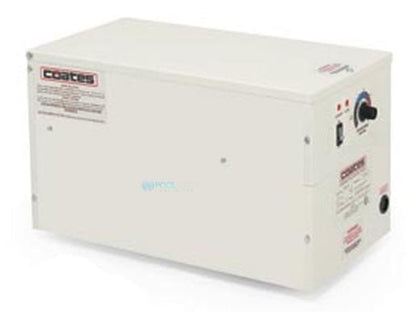
Coates Electric Heater 12kW Three Phase 208V, 32012CEMPN 32012CE
$2,18799
Out of stock
Email me when it is back
New customer? Create an account
Sign in to track an order, view past orders, start a return, and save the equipment you own so every part you see already fits it.
Three different machines share this page and they are not variations on one thing. A gas heater burns natural gas or propane and is the fast one, up to 399,000 BTU here, so it suits a pool you want warm this afternoon. A heat pump moves heat out of the air instead of making it, which is far cheaper to run and much slower. An electric resistance heater is the simplest to install and the dearest to run, which is why it turns up on spas and small pools.


Gas heaters from Raypak, Pentair, Hayward, Jandy and Lochinvar, in natural gas and propane, from 125,000 up to 399,000 BTU, with digital and millivolt ignition and ASME options for commercial work. Electric resistance heaters from Coates. Heat pumps and inverter heat and cool units from Raypak, Hayward, Madimack, Pentair and AquaCal.
Heat pumps have their own page at pool heat pumps. Igniters, exchangers, control boards and sensors are in heater parts.
Not sure what size you need? The pool heater size calculator works it out from your pool's length, width and the temperature you want. Pool heat pump vs gas heater sets out which type suits which pool, and pool heater error codes explains what a code on the display means.
How much is a pool heater?
It depends on the fuel and the size. At today's prices the heaters named here run from $969.99 to $4,836.00. A Raypak 105,000 BTU gas heater for an above ground pool is $2,119.00. A Raypak Digital 200,000 BTU natural gas heater is $3,023.00. A Raypak Digital 399,000 BTU natural gas heater is $4,426.00. A Moov 50,000 BTU inverter heat pump is $2,399.00. A Raypak Crosswind V 118,000 BTU heat pump is $4,836.00. A Coates 11 kW electric spa heater is $969.99. Each price is for the heater alone. Installation, gas piping and electrical work are extra.
Gas, electric or a heat pump?
Decide by how fast you need it warm and how often you will run it. Gas wins on speed and nothing else comes close: it is the only choice for a pool used at short notice, or for extending a season in genuinely cold weather. A heat pump wins on running cost by a wide margin because it moves heat rather than making it, but it works slowly and it depends on the air being warm enough to take heat from. Electric resistance is the simplest install, needs no gas line and no flue, and costs the most to run, which is why it suits spas and small pools.
Copper or cupro-nickel heat exchanger?
Cupro-nickel if the pool is salt, and it is worth the difference. The exchanger is the part the water actually flows through, and plain copper is fine in balanced chlorinated water but corrodes faster in salt or in water that is left aggressive. Cupro-nickel resists both, which is why it is offered as the upgrade on most gas heater lines. Our shelf is roughly three copper for every two cupro-nickel, and the heat pumps use titanium, which is why they are the least fussy of the three about water chemistry.
Does my elevation matter?
For a gas heater, very much, and it catches people out. Most gas heaters are rated for sea level up to about 2,000 ft, which is what the great majority of ours state, because thinner air changes how the burner draws and mixes. Above that you need a high altitude version, and some lines publish a model rated to 10,000 ft. Installing a standard unit too high means poor combustion and a heater that will not commission, so check the elevation rating on the product before ordering rather than after.
Natural gas or propane?
Whichever is already at the house, and do not plan to change it casually. The two are not the same appliance: they burn at different pressures and through different orifices, so a heater is built and certified for one of them. Some models are offered in both versions as separate products, which is what you will see on this page, and some manufacturers publish a conversion kit for their own unit. Buying the wrong fuel is the single most common heater return, and it is stated plainly on every product.
What size, in BTU?
Bigger than you think, and size on surface rather than volume. A pool loses most of its heat off the top, so a wide shallow pool loses more than a deep narrow one of the same gallons, and wind exposure matters more than either. Gas here runs 125,000 to 399,000 BTU and heat pumps 50,000 to 140,000, which is the real difference between them. An undersized heater does not fail, it just never quite catches up on the cold days you bought it for, and a cover does more for heat retention than any upgrade in size.