
Pool School, Pool Lifts
ADA Pool Lift Requirements: Which Pools Need One and What the Lift Must Do
Section 242 and section 1009.2 of the 2010 ADA Standards in plain terms: who has to provide an accessible entry, how many, and what the lift itself has to do.
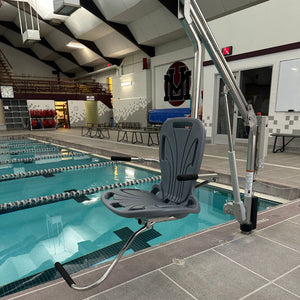
A pool open to the public, to guests or to members needs an accessible entry. Under 300 linear feet of wall, that is one entry, and it must be either a lift or a sloped entry. At 300 feet or more it is two, the primary one a lift or slope. Each spa needs its own. The lift must be attached to the deck during open hours, hold 300 lb, sink the seat 18 in and run without help. A residents only community pool and a private home are not covered.
How many accessible entries does your pool need?
Section 242 of the 2010 ADA Standards counts the pool's wall at the water line, not its area or its deck: a 20 x 40 ft rectangle is 120 linear feet, a round pool is 3.14 x its diameter, and an L or kidney shape is measured around the water's edge. Under 300 feet needs one accessible entry, a pool lift or a sloped entry. At 300 feet or more it needs two, and the primary one must still be a lift or a sloped entry. Each pool and each spa in a facility is counted on its own and needs its own entry whenever it is open.
The entry rule, pool by pool
Count every pool and every spa separately. Section 242 of the 2010 ADA Standards sets how many accessible entries each needs, and for an ordinary pool the length of its wall decides.
| Body of water | Accessible entries | What counts |
|---|---|---|
| Pool, under 300 linear feet of wall | 1 | A sloped entry or a pool lift |
| Pool, 300 linear feet or more | 2 | Primary: a sloped entry or a lift. Secondary: pool stairs, a transfer wall, a transfer system, or a second lift or slope |
| Wave pools, lazy rivers, sand bottom pools and pools entered at a single point | 1 | Any accessible type, whatever the wall length |
| Wading pool | 1 | Sloped entry only. A lift will not do |
| Spa | 1 | Transfer wall, transfer system or lift |
| Group of spas | 5 percent of them, never fewer than 1 | As for a single spa |
| Catch pool at a slide run out | None | Only an accessible route to its edge |
Measure the water's edge, not the deck or the cover. A 20 x 40 ft rectangle has 120 ft of wall. A round pool's wall is its diameter times pi, about 3.14. For a kidney or L shape, run a tape around the water line.
Pool stairs never serve as the primary entry. And one portable lift cannot cover both a pool and a spa: each entry has to be there for the whole time its own water is open.
What the lift has to do: section 1009.2
A lift that meets the count still fails if it misses any one of these.
| Section | Requirement | The figure |
|---|---|---|
| 1009.2.1 | Location | Water 48 in deep or less where the lift sits. If no part of the pool is that shallow, any spot works |
| 1009.2.2 | Seat over the deck | In the raised position the seat's centerline is 16 in or more back from the pool edge; deck slope between them 1:48 at most |
| 1009.2.3 | Open deck beside the seat | 36 by 48 in on the dry side of the seat, starting 12 in behind its rear edge; slope 1:48 at most |
| 1009.2.4 | Seat height | 16 to 19 in, deck to top of seat, at the loading position |
| 1009.2.5 | Seat width | 16 in or wider |
| 1009.2.6 | Footrest and armrests | A footrest that travels with the seat. A spa lift may skip it, though one is encouraged in water 34 in deep or more. Armrests are optional; the dry side one must fold out of the way or come off |
| 1009.2.7 | Operation | The rider works it alone, from the deck and from the water, and can call it back from either. One hand, no tight grip, pinch or wrist twist, 5 lb of force or less |
| 1009.2.8 | Submerged depth | Seat 18 in or more below the still water level |
| 1009.2.9 | Capacity | Rated for 300 lb or more, with a static load of 1.5 times the rating |
Seat backs, headrests and belts are encouraged, not required. Whether a given lift can put its seat 16 in from your edge and 18 in under your water depends on setback and draft: which pool lift fits your pool walks through both numbers. Lifts for public and commercial pools are grouped under ADA pool lifts.
Fixed or portable: what the Justice Department said
The most repeated error online is that portable lifts no longer comply. The Department of Justice's Title III guidance says a lift counts as fixed once it has been "attached to the pool deck or apron" by any means. Bolt a portable lift down with its fixing kit and it is a fixed lift. One kept in a closet and wheeled out on request is not.
The manufacturers sell the hardware that makes a portable lift fixed:
- S.R. Smith: the PAL2 ships with the Secure-It Kit, 200-1090A.
- Spectrum Aquatics: the Lockdown Anchor Kit for the Portable Motion Trek, 42672.
- Aqua Creek: the Mighty Voyager comes with a fixing anchor.
- Global Pool Products: the portable kit for the C-375 and C-450 bolts the lift to its deck anchor.
You may take the lift off the deck while the pool is closed, overnight or for the season. Portable lifts bought before March 15, 2012 that otherwise comply get a pass: on May 24, 2012 the DOJ said it would not enforce the fixed requirement as long as the lift is in position and working for every open hour. For a lift bought later, the duty is to fix it in place wherever that is readily achievable: easily done, without much difficulty or cost, decided one case at a time. That duty does not expire.
Higher insurance cost is no defense. If the compliant lift you ordered is on back order, keep the pool open and install it when it arrives.
HOA, condo, apartment and home pools
Title III covers hotels and motels, health clubs and fitness centers, recreation centers and public country clubs, and any business whose pool is open to customers or guests. Title II covers state and local government, which takes in city pools and public school and university pools.
A community pool open only to residents and the guests they bring is not covered. Neither is a private home. The exemption ends when the residents' pool serves outsiders: rented out for events, used for swim meets, camps or classes, or opened to non residents for a fee.
The DOJ does not name HOAs, condos or apartments. The route there is the Fair Housing Act: a resident with a disability can ask to install a lift, paying for it themselves, as a reasonable modification under that law. Separately, some building departments have made a lift a condition of a renovation permit, so ask before you file. A home pool can use any lift, rated for the ADA or not: see home pool lifts.
State rules: California, Texas and Florida
- California. Title 24, Chapter 11B follows the federal text. Since January 2, 2018, any lift shipped into the state needs a battery charging system that meets California Energy Commission rules. S.R. Smith sells BC versions of its control box, charger and battery, 1001495-BC-R. They do not swap with the standard LiftOperator parts, so check the serial before you reorder.
- Texas. Chapter 10 of the Texas Accessibility Standards, enforced by TDLR, mirrors section 1009.
- Florida. The Department of Health issues the operating permit under 64E-9 of the Florida Administrative Code, and the Florida Accessibility Code is the building department's to enforce. At least one county's inspection checklist wants 4 ft of deck width behind a lift mounted on the deck. Ask your county what it checks.
Tax credits and grants
Two federal tax provisions can apply when an existing business adds a lift. Neither applies to new construction, no source names pool lifts specifically, and your accountant should confirm before you count on either.
- Section 44, the Disabled Access Credit (Form 8826). For a business with thirty or fewer full time employees, or gross receipts of one million dollars or less in the prior year. It returns half of eligible spending between two hundred fifty and ten thousand two hundred fifty dollars, so a credit of up to five thousand dollars a year. It is non refundable, and it covers barrier removal and providing or modifying equipment.
- Section 190, the barrier removal deduction. Open to any business, up to fifteen thousand dollars a year.
A small business can use both. The worked example on ada.gov: spend twenty thousand dollars, take the five thousand dollar credit, and deduct fifteen thousand.
For a home pool, VA housing grants exist for adapting a veteran's home, and the VA decides whether a lift qualifies. Medicare does not generally cover a pool lift: CMS treats electric lifts as convenience items.
Keeping the lift compliant: the inoperable lift
A lift that sits on the deck but will not run is treated as no lift at all. A flat battery or a failed actuator puts you out of compliance just as surely as an empty deck. The battery has to be on the lift for every open hour.
- Keep a charged spare. Swap it in the moment the first one runs low. Pool lift batteries are listed by manufacturer.
- Charge it on each day the pool opens. S.R. Smith, Spectrum and Aqua Creek all say so.
- Run a test cycle before the first swimmer. Aqua Creek asks for one before each use.
- Keep the 36 x 48 in space empty. A lounge chair parked there undoes the install.
- Post the sign. S.R. Smith's Lift Available sign, 900-5000 tells guests the lift is there for them.
- Check a used lift's serial. CPSC recall 16-063 covers S.R. Smith Splash! units built 2013 to 2015, plus PAL Hi/Lo and Spa units, for their welds. The fix is a free replacement base or mast.
A water powered lift such as the Aquatic Access IGAT-180 has no battery to go flat; it runs on a 35 to 70 psi water supply instead. For the daily and seasonal routine on a battery lift, see pool lift battery, maintenance and winter storage. For everything a complete purchase includes, from anchor to cover, see what a pool lift costs and what installing one takes.
Products in this guide




Questions
Does a hotel pool that is only open to guests need a lift?
Yes. Hotels and motels are public accommodations under Title III, and a pool open to their guests is covered. Under 300 linear feet of wall it needs one accessible entry, a lift or a sloped entry. A hotel spa needs its own entry, and one portable lift cannot cover both, because each entry has to be available whenever its own water is open.
How do I measure the linear feet of pool wall for the ADA?
Measure the perimeter at the water's edge, not the deck, the coping or the cover. A rectangle is twice the length plus twice the width: a 20 x 40 ft pool has 120 ft of wall. A round pool is its diameter times pi, about 3.14. For a kidney or L shaped pool, run a tape around the water line. Under 300 ft, one accessible entry; 300 ft or more, two.
Can a Hoyer lift be used as a pool lift?
Not at a public pool. Section 1009.2.7 says the rider has to be able to run the lift alone, from the deck and from the water, with one hand and no more than 5 lb of force on the control. A patient lift needs someone else to move it, so it does not meet the standard whatever its capacity. At a home pool nothing forbids one, but the lifts on this page are built to set a seat 18 in under the water and bring it back up on its own, which is the job.
Is a pool lift with a dead battery still ADA compliant?
No. A lift on the deck that will not run, whether the battery is flat or the actuator has failed, counts as no lift. The battery has to be on the lift for every open hour. The practical answer is a second battery kept charged, swapped in as soon as the first runs low, and a test cycle before the pool opens each day.
Are pool lifts required in Florida?
Yes, for the same pools the federal rule covers: a public pool in Florida needs its accessible entry under section 242, and the building department checks the lift against the Florida Accessibility Code when it goes in. The Department of Health adds its own operating permit for public pools under Chapter 64E-9 of the Florida Administrative Code, and one county checklist asks for 4 ft of clear deck behind a deck mounted lift. File the building permit with the anchor drawing and the manufacturer's ADA statement.
Has the ADA pool lift rule changed for 2026?
No. The 2010 ADA Standards were the first federal standard with entry requirements for pools, wading pools and spas. New construction and alterations had to comply from March 15, 2012. A DOJ final rule published May 21, 2012 gave existing pools until January 31, 2013. Nothing in the rule has changed since.
Does Medicare pay for a pool lift at home?
Not generally. CMS treats electric lifts as convenience items, and no source says Medicare covers a pool lift. VA housing grants exist for adapting a veteran's home, and the VA decides whether a lift qualifies. A business adding a lift to an existing pool may be able to use the Section 44 credit and the Section 190 deduction instead.