
Pool School, Pumps
How Long Should I Run My Pool Pump?
Active Pool Supply · Updated October 2, 2026
Long enough to pass the whole pool through the filter at least once a day, as Hayward's variable speed manuals and DOE's Building America guide ask; the code sizes home pool equipment for one turnover every 12 hours. Hours = gallons / (GPM x 60): a 20,000 gallon pool takes 8.3 hours to turn over at 40 GPM and 16.7 at 20 GPM. On a variable speed pump, run slower and longer. Power falls with the cube of speed, so half speed draws an eighth of the power, and the same turnover in twice the hours uses about a quarter of the energy.
How long should you run your pool pump?
Long enough to pass the whole pool through the filter at least once a day, which is what Hayward's variable speed manuals and the Department of Energy's Building America guide ask. The hours are gallons divided by (GPM x 60). A 20,000 gallon pool moving 40 GPM needs 8.3 hours for one turnover; at 30 GPM it needs 11.1, and at 20 GPM 16.7.
The code asks more of the equipment: it sizes a home pool's pump and filter for one turnover at least every 12 hours. On a variable speed pump, pick the slowest speed that still makes your turnover and keeps the heater, chlorinator and skimmers working, then let it run. Power falls with the cube of speed, so a long slow run uses less energy than a short fast one.
How often the water should turn over
Every rule we read sets a turnover, not a number of hours. The code requires a timer but names no hours, and no pump manufacturer we read prints daily hours for a single speed pump. What they do set is how often the whole volume should pass through the filter:
| Source | Turnover | What it governs |
|---|---|---|
| 2024 International Swimming Pool and Spa Code, sections 810.1 and 704.4 | At least every 12 hours | How the circulation equipment of an inground or onground home pool is sized |
| ENERGY STAR | 12 hours at the pump's lowest speed, citing ANSI/NSPI-5 2003 | Setting up a new pump's flow |
| Hayward MaxFlo VS 500 and TriStar VS 950 manuals | At least every 24 hours | Filtering, with a reminder to check local requirements |
| DOE Building America guide | At least every 24 hours, and never quicker than 6 in normal running | Setting a variable speed pump; the minimum flow is gallons divided by 1,440 |
| PHTA-15 2021 | No quicker than 6 hours, or 36 GPM for a small pool | The most flow the filter and pipe are sized for, and the lowest flow that keeps the water clear and sanitized |
| Pentair and CaliMar manuals | No figure | Follow local codes on turnover and the sanitizer's feed ratio |
The code's 12 hours sizes the equipment. Hayward's and DOE's 24 hours describe how to run it, and ENERGY STAR's 12 sets the slowest speed. The Building America page prints both 12 and 24. Check which one your local code applies.
Work out your hours
Hours = gallons / (GPM x 60). Here is the sum for six pool sizes at four flows:
| Pool, gallons | 20 GPM | 30 GPM | 40 GPM | 50 GPM |
|---|---|---|---|---|
| 10,000 | 8.3 | 5.6 | 4.2, too fast | 3.3, too fast |
| 15,000 | 12.5 | 8.3 | 6.3 | 5.0, too fast |
| 20,000 | 16.7 | 11.1 | 8.3 | 6.7 |
| 25,000 | 20.8 | 13.9 | 10.4 | 8.3 |
| 30,000 | 25.0, over a day | 16.7 | 12.5 | 10.0 |
| 40,000 | 33.3, over a day | 22.2 | 16.7 | 13.3 |
A cell marked too fast asks more flow than PHTA-15 2021 allows that pool: the six hour turnover rate, or 36 GPM where that is higher. DOE's Building America guide is stricter on small pools: it says no turnover in normal running should take under six hours, which also rules out 5.6 hours on 10,000 gallons. A cell over a day cannot make one turnover in 24 hours.
The flow is the part people guess. Some pumps show it: Pentair's IntelliFlo3 VSF runs to a set GPM, and before it is programmed it holds 30 GPM around the clock. Nidec's Neptune replacement motor asks for two numbers when you program it: the pool's volume and the GPM the pump makes at full speed. Otherwise read the flow off the manufacturer's curve at your system's head, as the pool pump size guide explains, with a calculator for the sums.
Slower and longer uses less energy
A centrifugal pump follows the affinity laws, which the Department of Energy prints: flow moves in step with speed, head with its square, and power with its cube. Halve the speed and the flow halves while the power falls to an eighth. ENERGY STAR and Pentair both give that eighth.
So the same turnover at half speed takes twice the hours at an eighth of the power: about a quarter of the energy. That is our arithmetic on the cube law. DOE's tip sheet warns that the laws lose accuracy where a system has static head, and gives its own example: cut the speed by 20 percent and input power falls by roughly half.
Published examples land near the law, not on it. DOE's Building America guide puts a typical 1-1/2 HP pump at about 2,000 watts at 3,450 RPM and 593 watts at 2,400 RPM, a 70 percent cut for 30 percent less speed. The cube law gives about 673 watts. Treat every savings figure as an example:
| Source | What it compares | Energy saving it gives |
|---|---|---|
| ENERGY STAR fact sheet, 2017 | Certified pumps against standard pool pumps | Up to 70 percent |
| ENERGY STAR product page | Certified pumps against standard pool pumps | 20 percent in ground, 11 percent above ground |
| DOE Building America guide | Variable speed pumps, baseline not stated | 50 to 90 percent |
| Pentair | Variable speed and flow pumps, baseline not stated | Up to 90 percent of energy costs |
| Regal Rexnord | Century VGreen 270 motor against a standard single speed motor | 40 to 80 percent, by speeds, hours and plumbing |
Neither ENERGY STAR page defines the standard pump it measures against. Slow running has other gains in the manufacturers' telling: Hayward says a filter often catches smaller particles when the water moves slowly, and lists quieter running and less strain on the equipment. Building America says the long run keeps the pool skimming for more of the day, and the water clearer for it.
How slow is too slow
The floor is not the lowest number the keypad allows. Hayward says heaters, skimmers and chlorinators each need a minimum flow to work properly, and that a lower speed means a longer run. Pentair and CaliMar tell whoever sets the flow to weigh local turnover rules and the sanitizer's feed ratio. When Pentair's troubleshooting chart traces poor circulation to a speed set too slow, its answer is a longer filtration run.
The federal definitions, which PHTA-15 reprints, put a variable speed pump's lowest speed at no more than a third of its top speed, and a two speed pump's low speed at no more than half. To check a speed, find its flow and do the hours sum. If the hours come out longer than you are willing to run, step the speed up.
What the pump does out of the box
Most variable speed pumps ship with a schedule. It is written for a typical pool, not yours, so run the hours sum against it.
| Pump | Default schedule | Hours a day |
|---|---|---|
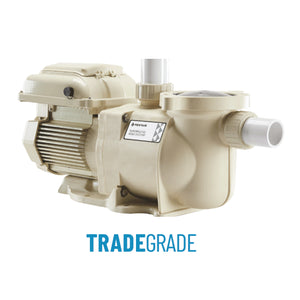
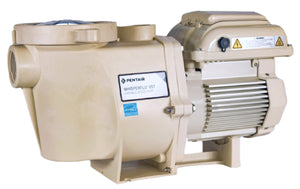
| Pentair SuperFlo VS and SuperFlo VST, WhisperFlo VS and VST | From 8 am: 3,000 RPM for 2 hours, 1,400 for 10, 2,200 for 2, then paused for 10 | 14 |
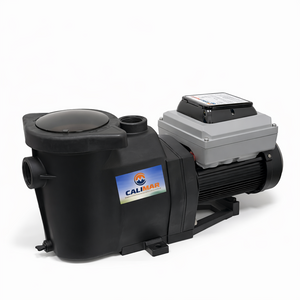
| CaliMar CMARVSP and CaliFlow | From 8 am: 3,000 RPM for 2 hours, 1,500 for 10, 2,500 for 2, 1,000 for 4, then paused for 6 | 18 |
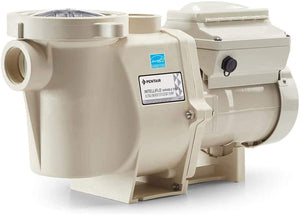
| Pentair IntelliFlo VS+SVRS | Nothing runs until you set the clock and a schedule. Presets of 1,100, 1,500, 2,350 and 3,110 RPM, with speed 1 the filtration speed | None until set |
| Pentair IntelliFlo3 VSF | 30 GPM around the clock if started before it is programmed | 24 |
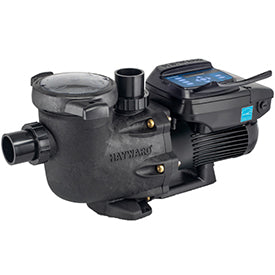
| Hayward MaxFlo VS 500 and TriStar VS 950 | Timer 1 runs midnight to 11:45 pm, its screen showing 1,725 RPM. Presets of 1,000, 1,750, 2,500 and 3,250 RPM | 23 hours 45 minutes |
| Hayward XE | Three blocks of 4, 8 and 12 hours, all at 50 percent speed | 24 |
Hayward's own documents disagree on its presets. The MaxFlo VS 500 and TriStar VS 950 manuals and the 115 V quick reference card give 1,000, 1,750, 2,500 and 3,250 RPM, while a 2018 quick reference card gives 1,150, 1,725, 2,300 and 2,875. The 1,725 RPM on the TriStar VS manual's timer screen is not one of its own four presets. Nidec's Neptune replacement motor offers one touch speeds of 1,380, 1,725 and 2,760 RPM, which Nidec ties to the 2021 federal speed settings.
Single speed and two speed pumps
A single speed pump has one flow, so the hours are the only thing you can change. Hayward's Super Pump manual and Pentair's SuperFlo and WhisperFlo manuals give no daily hours, so use the sum with the flow read off the curve at your head.
The code requires a time switch, or another control, that starts and stops pump motors on a preset schedule. It exempts pumps that public health rules need running around the clock, and pumps that drive solar or waste heat pool heating. ENERGY STAR says 6 hours a day instead of 24 cuts a filter pump's energy by 75 percent. That is one speed at one power for a quarter of the time, and it tells you nothing about a variable speed pump run slow. Where debris is the trouble, ENERGY STAR suggests a timer that runs the pump in many short spells.
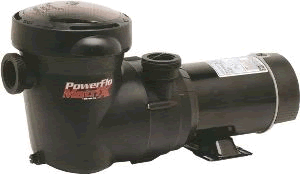
A two speed pump usually runs at 3,450 and 1,725 RPM, by DOE's Building America guide. Pentair's notice under California's Title 20 says two speed pumps made from January 1, 2008 must default to the low speed, with high speed overrides capped at two hours or one normal cycle, whichever ends first. On low the pump draws about an eighth of its high speed power and needs twice the hours, by the affinity laws. Hayward's Power-Flo Matrix 1.5 HP two speed is one, for above ground pools.
When a single speed motor fails, the replacement rules have changed. The federal motor rule requires variable speed control on standard size pool pump motors manufactured from September 29, 2025, and on small size motors from September 28, 2027. Standard size runs from 1.15 to 5 total horsepower and small size from 0.5 to just under 1.15. Replace the motor or the whole pump covers both routes, and the pool pump motors include variable speed replacements.
When to run it longer
- After storms and busy days. PHTA-15 says both bring in debris that can call for extra turnovers.
- When the water clouds. PHTA-15's water quality appendix notes that particles big enough for the filter to catch settle out when the pump stops, and ties clarity to running long enough, at a flow that lets the chemical feeder or salt cell do its work.
- In a brief freeze. Pentair's manuals say that in a mild climate, when freezing weather is temporary, the filtering equipment should run through the night. Under the federal rules, a pump or motor sold with freeze protection ships with it switched off, or set to start no warmer than 40F air, run no more than an hour before the temperature is checked again, and turn no faster than half speed.
- For the spa, the cleaner and water features. Pentair keeps the high speeds for spa jets, water features and priming, and ENERGY STAR says filtering needs half the flow a pool cleaner does. Keep those runs short. Pentair's IntelliFlo makes its two fastest presets egg timers so they cannot run on indefinitely, and Hayward's quick reference card allows its top speed 60 minutes a press, up to 6 hours. Starting a pump that has lost its water is in how to prime a pool pump.
Shopping for a pump that can run slow? The variable speed pool pumps are on one page.
Products in this guide
Questions about pool shock
Is it OK to run a pool pump 24 hours a day?
No manufacturer we read forbids it, and several schedule it by default: Pentair's IntelliFlo3 VSF runs 24 hours at 30 GPM before it is programmed, Hayward's XE pumps run 24 hours at 50 percent speed, and the TriStar VS 950's first timer runs 23 hours 45 minutes. The price is energy, and speed sets it. ENERGY STAR says a single speed pump run 6 hours instead of 24 uses 75 percent less. At half speed, by the cube law, a pump draws about an eighth of its full speed power.
How many hours should a variable speed pool pump run?
As many as it takes to turn the pool over at the speed you choose. Hours = gallons / (GPM x 60): 20,000 gallons at 30 GPM is 11.1 hours, and at 20 GPM 16.7. Slower costs less to run, because power falls with the cube of speed. Out of the box, Pentair's SuperFlo VS runs 14 hours a day, CaliMar's CMARVSP 18 and Hayward's XE 24. The code sizes equipment for one turnover every 12 hours; Hayward's manuals and DOE's Building America guide ask for one at least every 24.
How slow can I run a variable speed pump and still filter the pool?
Down to the speed that still turns the pool over in your hours and gives the heater, the chlorinator and the skimmers the minimum flow Hayward says each needs. Pentair runs filtration and heating on the low speeds and saves the high ones for spa jets, water features and priming. The manufacturers' default filtration speeds run from 1,100 to 1,725 RPM: Pentair's IntelliFlo 1,100, its SuperFlo VS 1,400, CaliMar 1,500 and Hayward's TriStar VS 950 1,725. If circulation suffers, Pentair's answer is more hours.
Should I run my pool pump when it freezes?
In a brief freeze, Pentair's manuals say yes: in a mild climate where freezing weather is temporary, run the filtering equipment through the night. If the pump or motor has freeze protection, the federal rules say it ships switched off or with defaults no warmer than 40F air, no more than an hour of running before the temperature is checked again, and no more than half speed. Check what yours is set to before you count on it.
Does running the pool pump longer make the water clearer?
Running it slower and longer can. Hayward says a filter often removes smaller particles when the water moves slowly, and DOE's Building America guide says the long, slow run keeps the pool skimming for much more of the day, with clearer water to show for it. PHTA-15's water quality appendix notes that particles the filter could catch settle out while the pump is off. Running fast is not the same: that appendix steers designers away from filtering treated water at high turnover rates.
Can I leave a two speed pool pump on low all day?
Yes, as long as low still turns the pool over and gives the heater and chlorinator their minimum flow. In California low has to be the default: Pentair's Title 20 notice says two speed pumps made from January 1, 2008 default to the lowest speed, with high speed overrides capped at two hours or one normal cycle, whichever ends first. By the federal definition the low speed is at most half the high, so low needs at least twice the hours, at an eighth of the power or less by the cube law.