
Pool School, Pumps
Replace the Pool Pump Motor or the Whole Pump?
Active Pool Supply · Updated October 2, 2026
Test first: a pump that hums is not always a dead motor. With the power off at the breaker, turn the shaft by hand and check the impeller, which Hayward names as the cause of a hum, then check the voltage is within 10 percent of the nameplate. A new motor replaces only the motor; a whole pump replaces everything. Under the federal motor rule, 10 CFR 431.485, motors of 1.15 to 5 total horsepower made from September 29, 2025 must be variable speed. A new motor must match the old one's mounting, voltage and phase and reach its total horsepower.
Motor or whole pump: what each one replaces
A new motor replaces the motor alone. The strainer pot, lid, housing, impeller, diffuser, seal plate and plumbing stay. A whole pump replaces all of it. Between the two sit the drive on some variable speed pumps and Hayward's power end, a motor with most of a new wet end already on it.
Which you buy is your decision. This page gives what it rests on: the tests that show whether the motor is really the fault, the federal motor rule, and what a replacement has to match.
| The repair | What it replaces | What stays | An example |
|---|---|---|---|
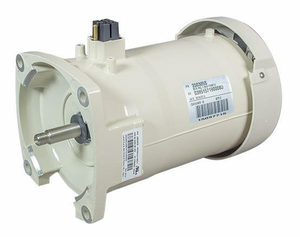
| Motor | The motor. Hayward's come with the slinger | Wet end and plumbing | Hayward's SPX1607Z1M, the motor its parts list gives for the SP2607X10 Super Pump |
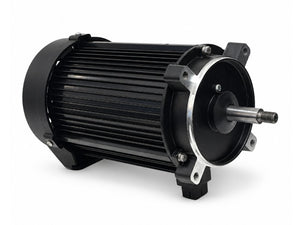
| Variable speed motor on a single speed pump | The motor, with speed control built in | Wet end and plumbing | Century VGreen 270, Nidec Neptune |
| Drive | The electronics on the motor | Motor, wet end, plumbing | Jandy kit R0688600, Pentair's IntelliFlo drive |
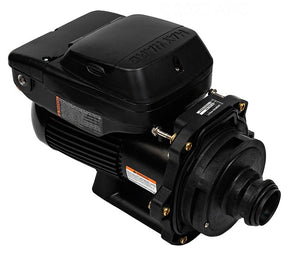
| Power end | Motor, seal plate, impeller, diffuser, shaft seal, housing O-ring | Strainer housing and plumbing | Hayward variable speed pumps |
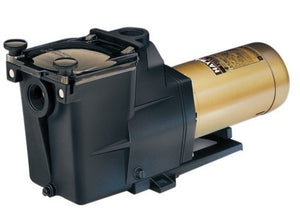
| Whole pump | Everything | The pipes. Jandy sets its VS FloPro's base to the old pump's height | Hayward's 1 HP Super Pump, W3SP2607X10 |
Is it really the motor? The manufacturers' tests
- Turn the power off at the breaker. Every test after this one puts your hands on the pump.
- Check the supply. Breaker, GFCI, fuses, relays, timer, and the wiring against the data plate. Hayward lists them all under a motor that will not start.
- Turn the shaft by hand. It should turn freely; Hayward's variable speed guide checks clockwise. If it is locked, Pentair says to take the pump apart and turn the shaft to clear the blockage. A motor that hums but will not start is, in Hayward's table, an impeller jammed with debris.
- Measure the voltage at the motor. Hayward, Pentair and Jandy all want it within 10 percent of the nameplate: 207 to 253 V on 230 V, the band Hayward prints for the TriStar VS 950. Outside it, Pentair says call a licensed electrician.
- Look for water under the motor. Water between motor and pump body is a failed mechanical seal, Jandy says, not a failed motor.
| What the pump does | What the manufacturers check first | What they replace if that is not it |
|---|---|---|
| Silent, will not start | Supply, wiring, timer; a shaft that turns freely | Hayward variable speed: the power end. Pentair SuperFlo VS and CaliMar, damaged shaft: the pump |
| Hums, will not start | Jammed impeller (Hayward); voltage | Hayward variable speed: the power end |
| Runs, then cuts out, again and again | Low voltage, undersized wire or an extension cord; the thermal overload trips until the cause is fixed (Hayward). A dirty fan cover (Pentair SuperFlo VS). Room to cool (Jandy) | Jandy: have an electrician check the connections and voltage |
| Bearings whine | A seal leak that let pool water into the bearings (Hayward) | Hayward single speed: fix the seal leak at once. Hayward HCP3000: motor and seal. Hayward variable speed: the power end. Pentair Challenger, shaft locked by a bad bearing: bearings or the pump |
| Weak flow, no air, no debris | Worn impeller and diffuser (Jandy) | The wet end, not the motor |
No manufacturer blames a capacitor. None of the troubleshooting tables we read names one as the cause of a hum. Inside Pentair's variable speed pumps, capacitors stay charged at 230 VAC with the power off, so Pentair says the drive and motor enclosures stay shut.
ENERGY STAR's signs that a pump needs replacing include one that buzzes without starting, gets too hot and shuts down or starts slowly, and one seven to ten years old. The manufacturers trace several of those to an impeller, a seal or the supply.
The federal motor rule
Under 10 CFR 431.485, the Department of Energy's standard for the motors that drive residential and small commercial pool pumps, a motor of 0.5 total horsepower or more must have variable speed control once it is made on or after the date for its size. The rule was published September 28, 2023.
| Size, total horsepower (THP) | What 10 CFR 431.485 requires | For units made on or after |
|---|---|---|
| Under 0.5 | At least 69 percent efficiency at full load | September 29, 2025 |
| 0.5 to under 1.15, small size | Variable speed control | September 28, 2027 |
| 1.15 to 5, standard size | Variable speed control | September 29, 2025 |
- It goes by the date the motor was made, not the date it is sold or fitted. We found nothing from DOE on installing a motor made before its date.
- Whole pumps have their own rule. Under 10 CFR 431.465, pumps made from July 19, 2021 have a minimum weighted energy factor to reach, set by size class without naming a speed.
- Total horsepower decides the class. By our arithmetic, a motor of 1.5 HP at a 1.30 service factor is 1.95 THP, standard size, so a new one made since September 29, 2025 must be variable speed under the federal rule.
- Freeze protection comes set low. On a covered motor that has it, freeze protection leaves the factory off, or set to 40F or below, at half speed or less, for an hour at most before it checks again. Check it after the swap.
California goes further: Pentair's manuals print the state's Title 20 rule, under which single speed pumps and replacement motors of 1 THP or more may not be sold or installed for residential pool filtration there. And some catalogs lag. Nidec's 2025 pool motor catalog still calls the federal regulation proposed, and Century's 2014 catalog predates it. The rule is final.
What a replacement motor has to match
Nidec names six things to match, most of them on the old nameplate: mounting, horsepower, service factor, voltage, frequency and phase. How close is close enough depends on whose rule you read.
| Whose rule | How close the new motor must be |
|---|---|
| Nidec (U.S. Motors) | Total horsepower equal to the old motor's or greater |
| Century | The same: equal or slightly higher |
| Jandy | Identical horsepower and service factor, Jandy approved motors only |
| Pentair, EQ commercial pumps | Pentair's own motor; otherwise frame, horsepower, service factor, voltage, phase and speed all exactly as before, or it may not fit or may fail early |
| Pentair, residential pumps | Set the motor support for the new motor's size |
| Hayward | No rule printed in the manuals read; one motor part number per pump model |
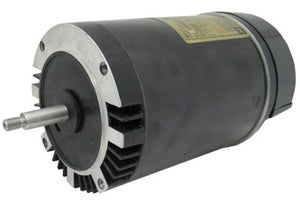
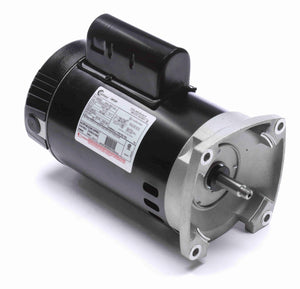
Mounting. Nidec sorts pumps by how the motor bolts on. Square flange: Pentair's WhisperFlo, IntelliFlo, SuperFlo and Challenger, Hayward's Max-Flo, Jandy's FloPro, Stealth and ePump, among others. C-flange with a threaded shaft: Hayward's Super Pump and Super II. Century's 1-1/2 HP B2854V1, a square flange motor in a 56Y frame, is a different mounting from the C-flange a Super Pump takes. Motors are under pool pump motors.
Total horsepower is nameplate horsepower times service factor, the figure federal rules and PHTA's standard both use. PHTA's example: 1.5 hp at a service factor of 1.65 is 2.475 THP.
Full rated or up rated. Two motors can wear the same horsepower and not be the same motor. Century's 2014 catalog labels a high service factor motor full rated and a low one up-rated:
| Century C-face motor, 2014 | THP | Service factor | Amps at 230 V |
|---|---|---|---|
| 1 HP full rated | 1.4 | 1.40 | 7.2 |
| 1.5 HP full rated | 1.95 | 1.30 | 9.2 |
| 1 HP up-rated | 1.0 | 1.00 | 6.0 |
| 1.5 HP up-rated | 1.5 | 1.00 | 7.2 |
The up-rated 1.5 HP draws what the full rated 1 HP draws. In place of a full rated 1.5 HP it is 0.45 THP short of Nidec's and Century's rule. Jandy calls its own replacement kit uprated, so read the service factor, not the word.
A variable speed motor on a single speed pump
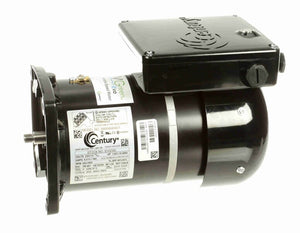
The motor manufacturers build for it. Regal Rexnord says its Century VGreen 270 takes the place of a single speed motor while the pump stays. It runs 600 to 3,450 RPM on 230 V, covers 3/4 to 2.7 THP, and comes square flange or C-face. Nidec sells its Neptune, 1.65 to 3.45 THP in square flange 48Y and 56J versions, as a drop-in.
Century also makes the VGreen Evo, 1.65 THP, by its title a square flange motor in a 48Y frame for 230/115 V. Fit is the motor manufacturers' claim; none of our sources measured one against the pump manufacturer's motor.
Motor, drive or power end on a variable speed pump
| Pump | Sold separately | The manufacturer's fix for a damaged shaft or dead motor |
|---|---|---|
| Pentair IntelliFlo VS+SVRS | Motor and drive; the drive lifts off as its own assembly | Not stated beyond the parts list |
| Pentair SuperFlo VS | Nothing: motor and drive are one assembly | Replace the pump |
| Hayward TriStar VS and other variable speed | A power end, no motor alone | Replace the power end |
| Jandy VS FloPro, VS PlusHP, ePump | The drive, kit R0688600 | Not printed in the pages read |
| CaliMar CMARVSP | Motor and drive for each size | Replace the pump |
For an IntelliFlo the motor is Pentair's 3.2 kW 350305S, and Pentair says never to remove the four screws on its intermediate drive cover, where the capacitor bank sits. For a 2.7 HP TriStar VS, Hayward's power end is SPX3206Z1VSPE, or SPX3206Z1VSPEVR with SVRS, and Hayward says to use the one made for your model. A 3 HP CaliMar takes the FB2030-M motor and FB2030-MD drive. The IntelliFlo and TriStar diagrams show where each part sits.
Does the shaft seal have to be replaced too?
You may read that a new seal goes in every time the motor comes off. No pool pump manufacturer we read says so. The one manual that does is Pentair's for its Flotec and Simer lawn and utility pumps.
- Hayward: change the shaft seal only when it leaks, or now and then for wear or damage. A Hayward variable speed power end arrives with a new seal fitted.
- Pentair: its residential manuals treat a new seal as optional during motor work. One that has run dry is the exception: Pentair says replace it.
- Jandy: sells its motor and its R0479400 mechanical seal separately, and changing the seal's ceramic half means taking the motor off the backplate.
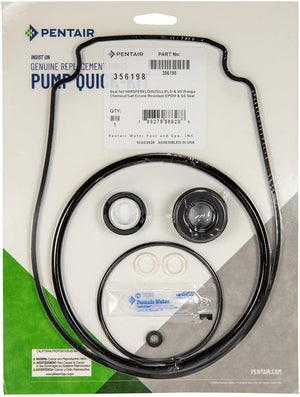
So the seal is a call made on its condition, and a leaking one should not wait: Hayward says it lets pool water into the bearings. Pentair's seal kit for the WhisperFlo and IntelliFlo, 356198, is one. Keep the faces clean and unscratched, and follow your manufacturer on what touches them: soap solution for Hayward's Super Pump and for Jandy, nothing at all on Hayward's variable speed seals, silicone in set places on Pentair's, by model.
Power, wiring and the GFCI
- Breaker off before you touch it. The pump stays off at the breaker from the moment the motor, wiring or lid is touched until the new motor is mounted and wired.
- GFCI. In the 2020 National Electrical Code, section 680.21(C) calls for Class A GFCI protection where a pool pump motor is fed from a branch circuit of no more than 150 V to ground and 60 A, and it names a motor replaced for repair. Towns adopt code editions on their own schedule, so ask which applies.
- The circuit. A motor of another horsepower or voltage may need another breaker and wire: Hayward's Super Pump chart gives 1 HP a 20 amp breaker on 115 V and 10 amp on 230 V.
- Refitting. Jandy points the starting capacitor toward the backplate handle. Pentair sets the motor support for the motor's size. Parts are on each pump's diagram, such as the Hayward Super Pump page.
Questions to answer before you order
- Did the motor fail the tests, or was it the impeller, a seal or the supply?
- Is the wet end sound, or worn as well?
- Does a motor exist that meets your pump manufacturer's matching rule, in the federal size class it falls in?
- On a variable speed pump, does the manufacturer sell a motor, a drive or a power end, or say replace the pump?
- For a whole pump, does the old size suit the pool? What size pool pump do I need works it out by flow, and how long to run a pool pump sets the schedule.
Whole pumps are under pool pumps and variable speed pool pumps. A new pump that will not prime: how to prime a pool pump.
Products in this guide
Questions about pool shock
Why does my pool pump motor hum but not start?
Hayward's troubleshooting table gives one cause: an impeller jammed with debris. With the power off at the breaker, check that the shaft turns freely by hand and clear the impeller. Then check the voltage at the motor, which Hayward, Pentair and Jandy all want within 10 percent of the nameplate. Hayward's variable speed guide replaces the power end only if it still hums after both. None of the manufacturers' tables we read names a capacitor as the cause.
What does the service factor on a pool pump motor mean?
It is a multiplier on the nameplate horsepower. The federal definition: how far above that figure the motor can run continuously without its insulation overheating. Horsepower times service factor is total horsepower, THP, also called service factor horsepower. In Century's 2014 catalog a 1 HP motor at 1.40 is 1.4 THP and at 1.00 it is 1.0. Replacement rules and the federal motor rule both go by THP.
Can an up-rated motor replace a full rated one of the same horsepower?
Not by the motor manufacturers' rule. Nidec and Century say a new motor's total horsepower must equal the old one's or exceed it. In Century's 2014 catalog a full rated 1.5 HP motor has a 1.30 service factor, so 1.95 THP, and the up-rated 1.5 HP has 1.00, so 1.5 THP: 0.45 short. Jandy goes further and requires the same horsepower and the same service factor. Read both figures off the old motor's nameplate.
Can I put a variable speed motor on my single speed pool pump?
The motor manufacturers say so. Regal Rexnord sells its Century VGreen 270 as a swap for a single speed motor with the pump kept, from 3/4 to 2.7 THP at 230 V, in square flange and C-face versions. Nidec makes its Neptune in square flange 48Y and 56J versions from 1.65 to 3.45 THP. Match the mounting to your pump first, and check the voltage: the VGreen 270 is a 230 V motor.
Do I need a new shaft seal when I replace the pump motor?
Not by any pool pump manufacturer's rule we found. Hayward says to replace the shaft seal only if it leaks. Pentair's residential manuals leave it to the installer. Jandy sells the motor and seal as separate kits. The one manual that requires a seal with every motor is Pentair's for its Flotec and Simer lawn pumps. A seal that has run dry is the exception: Pentair says it must be replaced. A Hayward variable speed power end comes with a new seal fitted.
Does a replacement pool pump motor need GFCI protection?
Under the 2020 National Electrical Code, yes. Section 680.21(C) calls for Class A GFCI protection where a pool pump motor is fed from a branch circuit of no more than 150 V to ground and 60 A, single or three phase, and it names a motor replaced for repair. Towns adopt code editions on their own schedule, so check which one applies where you live.
How do I know which motor fits my pool pump?
Start at the old motor's nameplate. Nidec lists six things to match: mounting, horsepower, service factor, voltage, frequency and phase. Mounting follows the pump: Pentair's WhisperFlo and IntelliFlo and Jandy's FloPro take a square flange, Hayward's Super Pump and Super II a C-flange with a threaded shaft. Then match total horsepower: equal or higher for Nidec and Century, identical for Jandy. Hayward prints no rule, only a motor part number for each pump.