
Pool School, Pumps
What Size Pool Pump Do I Need?
Active Pool Supply · Updated October 2, 2026
Size a pool pump by flow, not horsepower. Divide the pool's gallons by the turnover time in minutes: 20,000 gallons turned over in 8 hours needs 42 gallons a minute (GPM), and the code's limit of one turnover every 12 hours needs 28. Then check the suction pipe at the pump: held to PHTA-15 2021's 6 feet a second, 2 inch Schedule 40 PVC carries 63 GPM, or 84 at the 8 feet a second the code allows. Buy a pump whose manufacturer's curve gives your flow at your system's feet of head, and no more than the pipe carries.
Pool pump size calculator
Flow is the pool's gallons divided by the turnover in minutes. The 2024 International Swimming Pool and Spa Code, section 810.1, asks for a turnover at least once every 12 hours. What a pipe carries is its inside area times the water's speed on Schedule 40 PVC: 6 feet a second on the suction side and 8 on the return, the limits ANSI/PHTA/ICC-15 2021 sets for pool filtration piping. The code itself allows 8 on both. Gallons worked out from dimensions are an estimate.
What size pool pump do you need?
The one that moves your pool's water through the filter in the time you choose, through the pipe you already have. Flow decides it, measured in gallons a minute (GPM). Horsepower does not.
Divide the gallons by the turnover time in minutes. A 20,000 gallon pool turned over every 8 hours needs 20,000 / 480, which is 42 GPM. A 2 inch suction pipe carries 63 GPM at the 6 feet a second PHTA-15 2021 sets for the suction side, so 42 fits with room to spare. The pump to buy is one whose manufacturer's curve shows 42 GPM at the feet of head your plumbing adds up to. The calculator above does the same sums with the same figures.
How the calculator works, step by step
- Gallons. Type them in, or give the pool's length and width, or its diameter, with the average depth, and the calculator estimates them. Our example pool holds 20,000 gallons.
- Turnover time. How long the whole volume takes to pass through the filter once. The calculator offers 6, 8, 10 and 12 hours. Twelve is the slowest the 2024 International Swimming Pool and Spa Code allows for a home pool. Our example uses 8.
- Flow needed. Gallons divided by (hours x 60). 20,000 / 480 = 41.7, shown as 42 GPM.
- Suction pipe. Choose the pipe that enters the pump. The calculator uses Schedule 40 PVC's inside diameter, which the pipe manufacturer Westlake gives as the outside diameter less two minimum walls: 1.610 inches for 1-1/2 inch pipe, 2.067 for 2 inch, 2.469 for 2-1/2 inch and 3.068 for 3 inch. It multiplies the inside area by 6 feet a second, the PHTA-15 2021 limit on the filtration suction line, and by 8 for the return. A 2 inch line carries 63 GPM on the suction side and 84 on the return.
- Compare. 42 is under 63, so the pipe is not the limit. Had the flow been higher, the calculator would name the suction size that carries it, or you could choose a longer turnover.
- Find the pump. Look for one whose manufacturer's performance curve gives 42 GPM at your system's total head, or a variable speed pump that can be set to it. The calculator above lists the pumps we carry that reach that flow at the head you pick, from each manufacturer's curve at top speed. For any other pump, the curve is in its manual, and the pool pumps are sorted by manufacturer and speed.
Turnover: 12 hours is the limit, 6 is a ceiling
Three figures get called the turnover rule, and they do different jobs.
- 12 hours, the minimum. The 2024 code sizes home pool equipment for one turnover at least every 12 hours, inground (section 810.1) and onground (704.4). ENERGY STAR asks installers to set a new pump's lowest speed for a 12 hour turnover, citing ANSI/NSPI-5.
- 24 hours, a looser floor. Hayward's variable speed manuals ask for one turnover at least every 24 hours, subject to local rules. DOE's Building America guide sets a variable speed pump for one turnover a day, a minimum flow of gallons divided by 1,440, and prints the 12 hour figure on the same page.
- 6 hours, a ceiling on flow. PHTA-15 2021, the energy standard the code adopts for home pools, sets the maximum filtration flow at a six hour turnover, or at 36 GPM where six hours asks for less. Filter and pipe are sized from it, and the standard asks for the lowest flow that keeps the water clear and sanitized. Six hours is the fastest a pool should need, not a goal.
| Pool, gallons | GPM for 12 hours, the code's limit | 10 hours | 8 hours | PHTA-15 2021 ceiling: 6 hours, or 36 GPM |
|---|---|---|---|---|
| 10,000 | 14 | 17 | 21 | 36, the floor |
| 15,000 | 21 | 25 | 31 | 42 |
| 20,000 | 28 | 33 | 42 | 56 |
| 25,000 | 35 | 42 | 52 | 69 |
| 30,000 | 42 | 50 | 63 | 83 |
| 40,000 | 56 | 67 | 83 | 111 |
Below about 12,960 gallons the 36 GPM floor sets the ceiling, which is our arithmetic: 36 x 360 minutes. PHTA-15 adds that storms and heavy bathing bring in debris that can call for more than one turnover a day. How many hours the pump then runs is its own question, answered in how long to run a pool pump.
How much water your pipe can carry
The pipe at the pump's inlet caps the flow, whatever the pump could do. How fast water may move in it depends on whose rule you follow. The code allows 8 feet a second in a home pool's suction and return piping. PHTA-15 2021 holds the filtration suction line to 6 feet a second and its return to 8, and ICC's own CodeNotes say both rules apply: 6 on the filtration suction line, the code's figure everywhere else. The calculator uses PHTA-15's 6 and 8. The manufacturers print charts of their own, and they do not agree:
| Schedule 40 pipe | PHTA-15 2021 suction, 6 ft/s | PHTA-15 2021 return, 8 ft/s, which the code also allows on suction | Jandy, suction 6 ft/s / discharge 8 ft/s | Hayward Super Pump, 8 ft/s | Hayward TriStar, MaxFlo VS and XE, no velocity printed |
|---|---|---|---|---|---|
| 1-1/2 inch | 38 | 51 | 37 / 50 | 50.76 | 45 |
| 2 inch | 63 | 84 | 62 / 85 | 84 | 80 |
| 2-1/2 inch | 90 (PHTA's compliance sheet: 89) | 119 | 88 / 120 | 119 | 110 |
| 3 inch | 138 | 184 | 136 / 184 | 184 | 160 |
Figures are GPM. Hayward's two charts differ from each other by 4 to 24 GPM on the same pipe. Its TriStar VS 950 manual treats its chart as a safety limit: the system's flow must not exceed it, and the pump's top speed should be set to keep it there. Jandy adds that where the main drains supply all of the pump's water, the suction must stay at 6 feet a second or less with one drain completely blocked.
Distance and fittings count too. Jandy's chart assumes the equipment sits no more than 100 feet from the pool. Past that, go up a pipe size; its FHP manual adds half an inch of diameter for each 50 feet beyond 100. A suction side with over ten fittings wants the bigger pipe as well.
Leave a straight run before the pump inlet: four pipe diameters by PHTA-15, five by Pentair, CaliMar and Hayward's TriStar manuals. Hayward's Super Pump manual asks for five on one page and ten beneath its pipe chart. Pentair's example is a 2 inch pipe, which wants 10 inches clear of any valve, elbow or tee, and Pentair and CaliMar both want the suction pipe at least as large as the return.
Horsepower does not size a pump
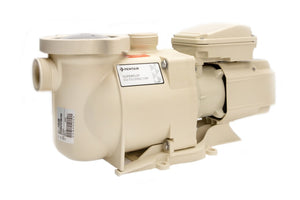
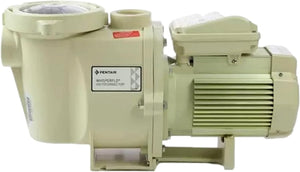
Two pumps with the same horsepower can move very different amounts of water. Pentair's SuperFlo and WhisperFlo single speed pumps are both sold as 1 HP pumps, and Pentair and the federal certification record rate each at 1.1 total horsepower. Read off the curves in Pentair's manuals at 50 feet of head, the SuperFlo, EC-348190 moves about 30 GPM and the WhisperFlo, EC-015583 about 53. Same rating, 23 GPM apart.
The horsepower on a label is not even one number. Total horsepower is the rated horsepower multiplied by the service factor, the margin above the nameplate a motor can carry continuously without overheating its insulation. That is the federal definition, and PHTA-15 calls the same product the capacity of the motor. Its example puts a 1.65 service factor on a 1.5 HP motor for 2.475 total horsepower.
Century, the motor manufacturer, calls a high service factor motor full rated and a low one up rated. Its 1.5 HP up rated motor pulls 7.2 A at 230 V, exactly what its 1 HP full rated motor pulls, and the two make 1.5 and 1.4 total horsepower. The federal motor rule, Nidec and Century all work in total horsepower, usually written THP. Compare that, then compare flow. If the pump is sound and only the motor has failed, replace the motor or the whole pump covers the match.
Feet of head, and how to read a pump curve
Head is the resistance the pump works against, stated in feet: the height the water is lifted plus the friction of every pipe, fitting, valve, filter and heater it passes. PHTA-15 calls the sum total dynamic head and says it only means something at a stated flow, because friction grows as flow grows. The code asks for a pump that delivers the filtration flow against the total dynamic head of the whole system.
Head climbs faster than flow. The federal test behind every pool pump's energy rating runs the pump against a fixed system curve: head = 0.0082 x flow squared. On that curve, by our arithmetic, 40 GPM meets 13 feet of head, 60 GPM meets 30 and 80 GPM meets 52. Double the flow and the head is four times as high.
No manufacturer or standard publishes a typical head for a home pool. DOE's Building America guide works it out the long way: measure the pipe runs, count each fitting as an equivalent length of pipe, and add the filter's and heater's losses from their manufacturers' charts.
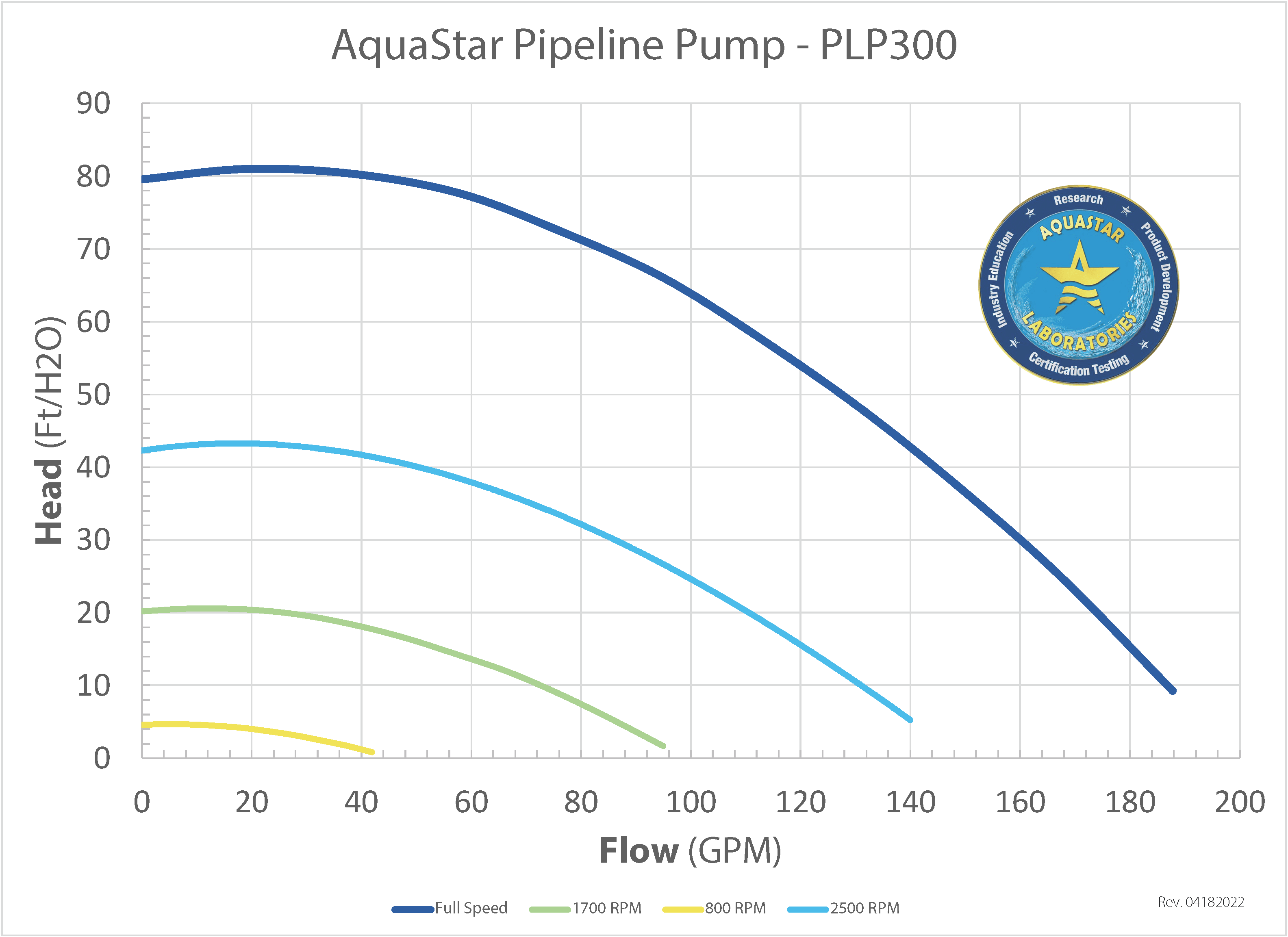
A pump curve plots head up the side and flow along the bottom, the same axes PHTA-15 uses for a system curve. Find your head, go across to the curve, and read the flow below. If it is at least the flow you need, the pump delivers. Here is what seven pumps make at full speed at one fixed point, 50 feet of head, read from their manufacturers' curves:
| Pump | Rating | Flow at 50 feet of head, full speed |
|---|---|---|
| Pentair SuperFlo, EC-348190 | 1.1 THP | About 30 GPM |
| Pentair WhisperFlo, EC-015583 | 1.1 THP | About 53 GPM |
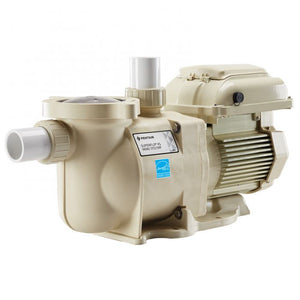
| Pentair SuperFlo VS, EC-342001 | 2.2 THP | About 83 GPM on 230 V |
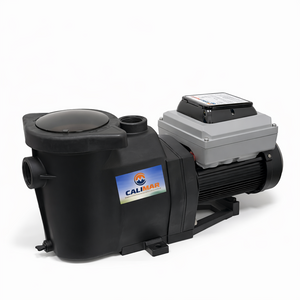
| CaliMar CMARVSP3.0 | 3 HP, by CaliMar | About 105 GPM |
| Pentair WhisperFlo VS, EC-011533 | 2.6 THP | About 127 GPM on 230 V |
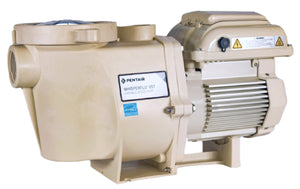
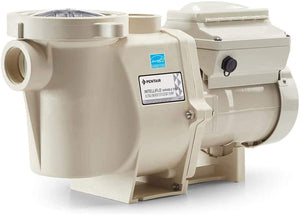
| Pentair IntelliFlo VS+SVRS, EC-011057 | 3.95 THP | About 148 GPM |
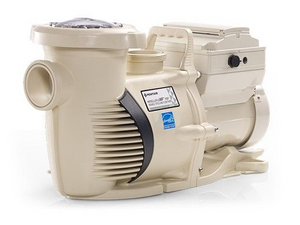
| Pentair IntelliFloXF VSF, 022056 | 3.95 THP | About 175 GPM |
Fifty feet is a place to compare curves, not a forecast. The federal test curve only reaches 50 feet at about 78 GPM, by our arithmetic, and on Pentair's curve the same SuperFlo that gives about 30 GPM at 50 feet gives about 100 at 20. Read your pump at your head.
Bigger is not better past what the pipe carries
A pump that can push more than the suction pipe carries does not filter any faster. It only drives the line past its limit. Pentair warns that the IntelliFlo VS+SVRS can reach 174 GPM or 104 feet of head and should be held back on old or doubtful equipment. On full speed it makes about 148 GPM at 50 feet, more than twice what a 2 inch suction carries under PHTA-15's 6 feet a second. Pentair ships its IntelliFlo3 VSF with flow limits of 90 GPM on the 1.5 HP model and 140 on the 3 HP, and pressure limits of 20 and 30 psi.
The filter has a limit as well. PHTA-15 2021 sizes it on the same maximum flow, at 0.375 GPM per square foot of cartridge, 20 for sand and 2 for DE. A 20,000 gallon pool tops out at 56 GPM, so by our arithmetic it wants about 148 square feet of cartridge, 2.8 of sand or 28 of DE.
A variable speed pump settles the question from the other side. Set its everyday speed to the flow you worked out, and cap its top speed at what the pipe carries, as Hayward's TriStar VS 950 manual asks. Pentair runs filtration and heating on the low speeds and keeps the high ones for spa jets, water features and priming. The variable speed pool pumps are on one page.
Above ground pools
The code's 12 hour turnover covers onground storable pools too, so the flow sum is the same: a 15,000 gallon above ground pool needs 21 GPM to turn over in 12 hours and 31 in 8. What changes is the pipe rule. PHTA-15 2021 exempts aboveground and onground systems from its flow and pipe sizing sections, so its 6 feet a second suction limit does not bind them. Go by the pump manufacturer's own chart.
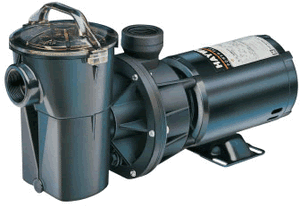
Hayward's 1 HP Power-Flo LX, for one, plugs in on a 3 foot cord and has 1-1/2 inch ports. The rest are under above ground pool pumps.
Flow in GPM at each head for the 38 pumps the calculator lists
Each figure is the pump's flow in gallons a minute at full speed, read from its manufacturer's published performance curve, linked under the pump. A variable speed pump can be set to any flow below its figure. A dash is a head the curve does not reach; we do not extend a curve past what the manufacturer drew.
Products in this guide

Questions
How many GPM does a 20,000 gallon pool need?
About 42 GPM to turn the water over in 8 hours: 20,000 gallons divided by 480 minutes. At the code's limit of one turnover every 12 hours it is 28 GPM, and over 10 hours 33. PHTA-15 2021 puts the top of the range at a six hour turnover, 56 GPM for 20,000 gallons, and sizes the filter and pipe from it. Anything from 28 to 56 GPM satisfies both, so pick the turnover you want and a pump that delivers it at your head.
How many GPM can 1-1/2 inch and 2 inch pool pipe carry?
At PHTA-15 2021's 6 feet a second, its limit on the filtration suction line, 1-1/2 inch Schedule 40 PVC carries 38 GPM and 2 inch carries 63. At the 8 feet a second the code allows in home pool suction and return piping, they carry 51 and 84. Jandy's chart gives 37 and 62 for suction, and Hayward's TriStar chart gives 45 and 80 with no velocity printed. Where the main drains supply all the water, Jandy holds the suction to 6 feet a second even with one drain blocked.
Can a pool pump be too big for the plumbing?
Yes. Past what the suction pipe carries, a bigger pump only pushes water faster than the limits allow. A 2 inch suction carries 63 GPM under PHTA-15 2021's 6 feet a second and 84 at the code's 8. Pentair's IntelliFlo VS+SVRS makes about 148 GPM at 50 feet of head on full speed, and Pentair warns it can reach 174 GPM and should be limited on older equipment. Hayward's TriStar VS 950 manual says to set the top speed so the flow stays inside its pipe chart.
How do I read a pool pump performance curve?
The curve plots feet of head up the side and flow in GPM along the bottom. Find the head your system works against, go across to the curve, then down to read the flow. If that flow is at least what your turnover needs, the pump delivers. A variable speed pump's manual draws a curve for each speed, and slower curves sit lower: Pentair's IntelliFlo VS+SVRS gives about 148 GPM at 50 feet on full speed and about 114 at its 3,110 RPM preset, and its three slower presets never reach 50 feet.
Does a variable speed pump change what size I need?
It changes what you size for. Its full speed curve has to cover the most you will ask of it, a spa or a cleaner, and its everyday speed is set to the filtration flow you worked out. Hayward's TriStar VS 950 manual says to cap the top speed at what the pipe chart allows, and Pentair warns that the IntelliFlo should be held back on old equipment. Under the federal motor rule, standard size pool pump motors made from September 29, 2025 on must be variable speed control motors.
How big a filter does my pump flow need?
PHTA-15 2021 sizes the filter on the pool's maximum filtration flow: a six hour turnover, or 36 GPM for a pool small enough that six hours asks for less. Divide that flow by 0.375 GPM per square foot for a cartridge, 20 for sand or 2 for DE. A 20,000 gallon pool tops out at 56 GPM, so it needs about 148 square feet of cartridge, 2.8 of sand or 28 of DE. A 10,000 gallon pool sizes on the 36 GPM floor: 96 square feet of cartridge.