
Pool School, Salt Systems
How to Convert a Pool to Salt Water
Active Pool Supply · Updated October 1, 2026
Yes, a chlorine pool converts to salt water, and without draining: no manufacturer's manual we read asks for it, and draining appears only as the fix for a reading that is out of range. You install a control or power center and a cell, plumbed into the return line after the filter and heater, with a flow switch or sensor. Balance the water first, then add salt to the level that system's manufacturer sets: 3,200 ppm for a Hayward AquaRite, 3,600 for a Pentair IntelliChlor. It is still a chlorine pool. The cell makes the chlorine from the salt.
Can you convert a chlorine pool to salt water?
Yes, and the water stays where it is. We read the manuals from Hayward, Pentair, Jandy, AutoPilot, CompuPool and Solaxx, and not one asks you to empty a chlorine pool first. That is an absence across those documents, not a line any manufacturer prints. A drain is only the cure for a reading that is out of range: salt, calcium hardness or cyanuric acid that is too high, or nitrates.
A salt pool is still a chlorine pool. Hayward and Jandy describe one loop: the cell turns dissolved salt into chlorine, the chlorine kills bacteria and algae, then it goes back to salt.
What a salt system is, and what comes in the box
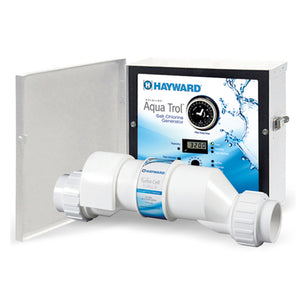
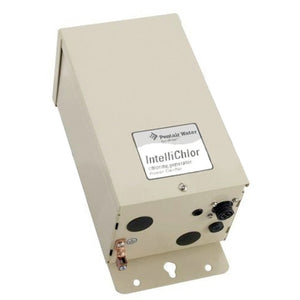
Three parts: a control or power center that turns house current into low voltage DC, a cell that makes the chlorine, and a flow switch or sensor that stops the cell when water is not moving. Several manufacturers sell the power supply apart from the cell.
| System | What the manual lists with it | Separate, or not included |
|---|---|---|
| Hayward AquaRite, AquaRite 900 | Control, Turbo cell, flow switch, cell unions | Adapters for 1.5 in pipe |
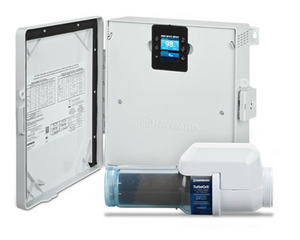
| Hayward AquaRite S3 | Electronics unit, cell, flow switch | Supply wire, conduit, and the Smart Relay a single speed pump needs |
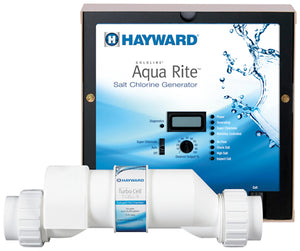
| Pentair IntelliChlor Plus, LT | Cell, two unions, acid wash stand | The power supply. Pentair lists the LT15, LT25 and PLUS30 two ways, cell only and cell with power supply, under different part numbers |
| Pentair IntelliChlor IC20, IC40, IC60 | Cell | PC100 Power Center kit |
| Pentair iChlor | Cell, unions, and a Power Pack (iChlor 15) or PC100 (iChlor 30) | Salt |
| Jandy AquaPure, PureLink | Cell kit: cell, unions, sensor, DC cord | Control center or power center, and salt |
| Jandy TruClear XL | Cell, union nuts, tailpieces | TruClear Smart Power Pack, the only supply it runs on |
| AutoPilot ChlorSync | Cell with two unions | ECP0312 Power Center |
| AutoPilot Pool Pilot Digital | Digital control | A manifold is also required: strainer, Tri-Sensor, cell, bypass valve |
| Solaxx Saltron Reliant | Power supply box, cell, flow sensor | Reducers for 1.5 in pipe |
Fitting an IC20, IC40 or IC60 to a pool that never had one? Add the PC100 Power Center.
What size salt system does your pool need?
Buy for the gallons in the pool. These are the manufacturers' own ratings, with chlorine output per day.
| System | Models | Pool size, gallons | Chlorine a day |
|---|---|---|---|
| Hayward AquaRite, AquaRite S3 | AQR3, AQRS315 / AQR9, AQRS325 / AQR15, AQRS340 | 15,000 / 25,000 / 40,000 | Not printed in the manuals |
| Hayward AquaRite 900 | AQR925 / AQR940 | 25,000 / 40,000 | Not printed |
| Pentair IntelliChlor Plus, LT | LT15 / LT25 / PLUS30 / PLUS40 / PLUS60 | 15,000 / 30,000 / 30,000 / 40,000 / 60,000 | 0.65 / 0.9 / 1.1 / 1.4 / 2.0 lb |
| Pentair IntelliChlor IC | IC15 / IC20 / IC40 / IC60 | 15,000 / 20,000 / 40,000 / 60,000 | 0.60 / 0.70 / 1.40 / 2 lb |
| Pentair iChlor | 15 / 30 | 15,000 / 30,000 | 0.6 / 1.0 lb |
| Jandy AquaPure | 700 / 1400 | 12,000 / 40,000 | 0.625 / 1.25 lb |
| Jandy TruClear XL | One model | 45,000 | 1.52 lb |
| AutoPilot ChlorSync | CS30 / CS40 / CS50 | Not printed | 1.1 / 1.4 / 1.7 lb |
| Solaxx Saltron Reliant | CLG225A / CLG240A | 25,000 / 40,000 | 1.15 / 1.65 lb |
| Solaxx Resilience | E40 | 40,000 | 1.4 lb |
Pentair's guide prints 30,000 gallons for the LT25, the PLUS30's figure, while the cell's own listing rates it for 25,000. Hayward's product page for the T-CELL-15 shows 1.45 in a field labelled Salt (lbs/day), a figure no manual repeats. CompuPool's ratings change with the document: the CPSC36 is 40,000 gallons on the USA brochure, 35,000 in the Australian manual.
- Jandy's general rule: a pool near the maximum size, used year round in hot water, may call for a larger generator or a second unit.
- Solaxx's Resilience footnote: the 40,000 gallon figure assumes cyanuric acid, and warm climates, heavy bather load and lap pools call for a larger model.
- Hayward: silent on oversizing. Its warranty excludes installation on a pool larger than the rating.
For a 40,000 gallon inground pool the complete Hayward system is the AquaRite W3AQR15. The W3AQR9 covers 25,000 gallons, the W3AQR3 15,000, and the AquaRite S3 AQRS340 runs on anything from 1,200 to 8,000 ppm of salt. Shop all salt chlorine generators.
What to check on the pool before you buy
Pentair calls salt inherently corrosive. Check what the water will touch.
- Salt already there. Hayward, Pentair, Jandy, CompuPool and Solaxx all say to test first.
- Metals and nitrates. Hayward and AutoPilot want metals at 0 ppm. In water that is not new, Hayward asks for a quart of metal remover and a quart of non-copper algaecide. Solaxx says nitrates mean a partial or full drain.
- Calcium hardness. Jandy's TruClear XL manual wants 200 to 400 ppm and stops the install at 800 ppm or more, because the cell scales fast and fails.
- Stone. Hayward sends owners of natural stone coping or decking to a stone installation specialist first, and its warranty excludes degradation of natural stone in or beside the pool. Jandy says to seal all masonry.
- The heater. Heater manufacturers cap salt: Hayward's Universal H-Series and Pentair's MasterTemp at 5,000 ppm, Raypak at 4,500.
- An automatic cover. Cover-Pools says aluminum cover parts on a bonded salt pool can show galvanic corrosion inside two to three years.
- Ladders and rails. Jandy wants every metal part to be high grade stainless steel. S.R. Smith lists a zinc anode as rail protection, without naming salt pools.
No salt system manufacturer we read recommends a sacrificial anode. Solaxx has an installation sheet for an anode tee that makes no claim for it. A 2 in inline anode is a part you can add, on your own judgment.
On biguanide: none of the manuals we read covers the change, so we print no procedure.
Where the cell goes in the plumbing
In the return line, after the filter and the heater. Pentair's MasterTemp manual gives the reason: a check valve between heater and chlorinator stops concentrated chemicals siphoning back. Hayward's H-Series manual and Raypak ask for the same valve.
- Hayward AquaRite: after all the equipment, on 2 in PVC, with at least 12 in of straight pipe ahead of the flow switch. No minimum flow is printed.
- Pentair IntelliChlor Plus and LT: 3 ft or more from the heater's outlet, behind a straight run of 12 to 18 in. Vertical is preferred, flow going up and cord pointing down. Laid flat, the control panel faces up. Flow is 25 to 105 gpm, with a bypass loop above 80. The iChlor starts at 20 gpm.
- Jandy AquaPure: the common line after the heater, horizontal or vertical. No gpm figure is printed.
- Jandy TruClear XL: last before the pool, upright on a pipe within 10 degrees of level, never on a vertical pipe. 30 gpm minimum.
- AutoPilot ChlorSync: horizontal, 20 gpm minimum, a bypass kit above 80 gpm. The Pool Pilot Digital manifold is vertical only.
- Solaxx Saltron Reliant: ahead of any tees in the return, horizontal or vertical. No gpm figure is printed.
Pentair puts an in-line tablet feeder downstream of the cell. So "the cell goes last" holds for a TruClear XL and fails on a Pentair pad with a feeder.
The wiring, and who should do it
One rule is shared: the cell has power only while the pump runs. PHTA says a generator makes hydrogen gas and must be electrically interlocked with the circulation pump, with the flow device as secondary protection. Check, clean or replace a flow switch. Never defeat one.
- Hayward AquaRite: powered from the pump timer's load side, to local and NEC codes. It ships set for 240 VAC and converts to 120. Bond it with 8 AWG copper.
- Pentair: only a qualified professional should install and service it. The power center goes on the load side of the pump timer, relay or automation system. Its guide calls a GFCI protected circuit for the PC100 recommended, not mandatory. Local code decides.
- Jandy: requires a licensed electrician for all electrical work. The AquaPure is fed off the pump relay's load side, factory wired for 240 VAC. The TruClear XL must be on a GFCI protected circuit.
- AutoPilot ChlorSync: a licensed electrician or certified electrical contractor should make every connection, on a GFCI protected circuit, 10 ft or more from the pool wall.
- Solaxx Saltron Reliant: a licensed electrician must do the electrical work, on a GFCI protected circuit of 6 A or more.
Start up, in order
- Balance the water. Hayward wants the chemistry in balance before the unit is switched on.
- Raise chlorine another way where the manufacturer says so. AutoPilot wants free chlorine at 2.0 to 4.0 ppm before a ChlorSync starts, since it is built to maintain, not to shock. Pentair shocks when demand is high and waits for 2 to 4 ppm. Jandy shocks and waits for 1 to 3 ppm.
- Test the salt already in the pool.
- Add salt with the pump running. Hayward asks for sodium chloride over 99% pure, Pentair for 99.8%. Pentair, Jandy and Solaxx keep it out of the skimmer. Jandy sets output to 00% first, and CompuPool turns the chlorinator off. The pool salt calculator gives the pounds.
- Brush and circulate. Hayward, Pentair and Jandy all say 24 hours.
- Verify the reading. Pentair checks it on the cell and with a separate test.
- Switch the cell on, after the wait in your system's row.
Salt, stabilizer and the wait all change with the system. Use the row for yours.
| System | Salt | Stabilizer | Before the cell runs |
|---|---|---|---|
| Hayward AquaRite | 2,700 to 3,400 ppm, 3,200 optimal | 30 to 50 ppm outdoors | Not stated. The pump runs 24 hours |
| Hayward AquaTrol | 2,700 to 3,400 ppm | 60 to 80 ppm | Not stated |
| Pentair IntelliChlor Plus, LT | 3,600 ppm target, 2,600 to 4,500 allowed | 0 to 50 ppm | Circulate 24 hours, then verify |
| Pentair iChlor | 3,600 ppm ideal, 3,000 to 4,500 | 30 to 50 ppm | 24 hours |
| Jandy AquaPure | 3,000 to 3,500 ppm | 50 to 75 ppm, 75 to 85 in water above 85F | 24 hours at 00% output |
| Jandy TruClear XL | 3,000 ppm minimum | 30 to 50 ppm | Verify salt after 48 to 72 hours |
| AutoPilot ChlorSync | 3,500 to 4,500 ppm, 2,300 minimum | 30 to 50 ppm | May start immediately once balanced |
| Solaxx Saltron Reliant | 3,500 ppm ideal | 60 ppm, 40 with pH and ORP sensors | Not stated |
New plaster waits before salt goes in: 10 to 14 days by Hayward's manual, a month by Pentair's, 30 days by Jandy's and AutoPilot's.
Above ground pools
Buy a system built for one.
- Hayward AquaTrol: rated to 18,000 gallons above ground, with its own pump timer. The return jet model hangs the cell straight down below the return jet and plugs into a GFCI receptacle.
- Hayward Salt and Swim SAS-ABG: up to 23,000 gallons, return jet mounted, on a 120 V cord.
- Solaxx Saltron Reliant AG: 20,000 gallons on Solaxx's product page, 25,000 in its brochure, 1.15 lb a day in both.
- Solaxx Saltron Retro: hangs on the pool wall with no plumbing. 0.4 lb a day, for pools to 20,000 gallons.
Pentair says not to use the IntelliChlor or iChlor with storable or steel pools. Jandy keeps the TruClear XL to permanent pools, and Hayward bars the Salt and Swim 3C from above ground pools. We found no other manufacturer statement on steel walls or frames.
After the conversion: what the routine becomes
The generator makes chlorine and does not measure it. Pentair and AutoPilot both say so, and PHTA adds that it supplies no stabilizer. You still test.
- Testing. Pentair: pH, alkalinity and free chlorine weekly; salt, cyanuric acid, calcium hardness and metals monthly. Jandy AquaPure: chlorine, pH, alkalinity and hardness daily, salt and stabilizer monthly.
- Inspecting the cell. Hayward every 3 months, Pentair at least every two, Jandy AquaPure monthly at first, CompuPool every six months, Solaxx monthly. PHTA says scale forms even in balanced water. See how to clean a salt cell.
- Topping up salt. Hayward says salt leaves through splashing, backwashing and draining, never by evaporation.
- Wear. PHTA notes that every acid cleaning, and polarity reversal too, takes life off a cell. See when to replace a salt cell.
What a conversion consists of
We print no cost figure. It is six things:
- The system: control or power center, cell, and flow switch or sensor.
- Salt. From zero, Hayward's chart puts 267 lb into 10,000 gallons to reach 3,200 ppm, and Pentair's 300 lb to reach 3,600.
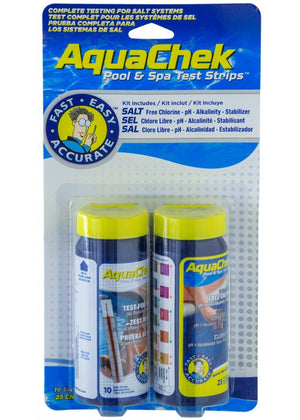
- A salt test, such as the AquaChek salt system test kit.
- Stabilizer, if the pool sits under your system's range: cyanuric acid in a 5 lb pouch.
- Fittings: adapters for 1.5 in pipe, and a check valve where there is a heater.
- Labour: an electrician where the manual requires one, and a plumber if you do not cut pipe yourself.
Products in this guide

Questions
Do I have to drain my pool to convert to salt water?
No. None of the salt system manuals we read, from Hayward, Pentair, Jandy, AutoPilot, CompuPool or Solaxx, asks you to empty a chlorine pool first. A drain comes up only to correct a reading: salt, calcium hardness or cyanuric acid that is too high, or nitrates, for which Solaxx calls for a partial or full drain. For water that is not new, Hayward asks only for a quart of metal remover and a quart of non-copper algaecide before the switch.
Can I convert an above ground pool to salt water?
Yes, with a system made for one. Hayward rates the AquaTrol to 18,000 gallons above ground and the Salt and Swim SAS-ABG to 23,000, and both plug into a GFCI outlet. The Solaxx Saltron Retro hangs on the wall of a pool up to 20,000 gallons with no plumbing. Pentair says not to use its IntelliChlor or iChlor with storable or steel pools, and Jandy rules the TruClear XL out for storable pools.
Is a salt water pool still a chlorine pool?
Yes. The cell makes chlorine out of the salt, and that chlorine does the sanitizing. Indiana's health department says salt itself is not a disinfectant. PHTA adds that a generator adds no stabilizer and no balancing chemicals, so cyanuric acid may still be needed. Pentair notes that its generator only produces chlorine and does not monitor the level, so you keep testing.
What do I need to convert my pool to salt water?
A salt chlorine generator sized to the pool: a control or power center, a cell, and a flow switch or sensor, which some manufacturers pack in one box and some sell in two. Then salt, to the level that system's manufacturer sets, a salt test, and stabilizer if the pool is low. Add pipe adapters if the plumbing is 1.5 in, and a licensed electrician where the manual requires one, as the Jandy and Solaxx manuals do.
Will a salt system damage my pool heater?
The heater manufacturers allow salt up to a printed ceiling and warn about what lies past it. Hayward lists 2,700 to 5,000 ppm for the Universal H-Series and flags high salt as corrosive to the exchanger. Pentair describes the MasterTemp as designed for salt system pools, at 2,000 ppm minimum, 3,200 ideal and 5,000 maximum. Raypak sets 4,500 ppm, and says a salt chlorinator left uncontrolled can raise chlorine far enough to damage the heater, outside its warranty.
How long after adding salt can I turn on the salt cell?
It depends on the manufacturer. Pentair and Jandy AquaPure have you brush, circulate for 24 hours and verify the reading first, and Jandy holds output at 00% meanwhile because a cell run without salt is damaged. The Jandy TruClear XL verifies salt after 48 to 72 hours. Hayward asks for several hours with the Salt and Swim, a day if possible. AutoPilot lets the ChlorSync start right after the water is balanced, though its salt display can read wrong during the first 24 hours of circulation.
Can I still use chlorine tablets with a salt system?
The rule on record is Pentair's. Its IntelliChlor guide warns against using trichlor or dichlor together with a salt chlorine generator, and against bromide products, so check what your tablets are. If an in-line feeder stays on a Pentair pad, Pentair wants it plumbed after the cell to protect the cell. We found no manufacturer statement that a feeder must come out. PHTA says a generator that is sized and working properly ought to cover daily sanitizing alone.