
Pool School, Salt Systems
When to Replace a Salt Cell
Active Pool Supply · Updated October 1, 2026
A salt cell is a wear part. Pentair prints about 10,000 hours, roughly five years of average use, for IntelliChlor IC and iChlor cells, CompuPool prints 12,500 hours for the CPX, and Hayward's Salt and Swim cells are timed at 1,500 or 3,000 hours. Hayward, Jandy and AutoPilot print no life for their main cells in the manuals we read. Replace a cell when it is clean, the salt is right by an independent test, the water is warm enough, flow is good, and it still makes too little chlorine or the system's own diagnostics say it is worn.
How long a salt cell lasts, by manufacturer
A salt cell is a wear part: its plates wear down as it makes chlorine. Three manufacturers print a figure for how long that takes. The rest print none in the manuals we read.
| System | Cell life the manufacturer prints | Where |
|---|---|---|
| Pentair IntelliChlor IC and iChlor | About 10,000 hours, roughly five years of average use | Guides 520589 Rev. R and 522709 Rev. G |
| Pentair IntelliChlor Plus, LT | Not printed. A run time meter only | Guide 523854 Rev. B |
| CompuPool CPX | 12,500 hours in normal use | CPX manual |
| CompuPool CPSC | Not printed | CPSC manual |
| Hayward Salt and Swim | Timed cells: 6 months or 1,500 hours, 12 months or 3,000 hours | Manual 092463 RevC |
| Hayward TurboCell | Not printed | Owner's manuals, troubleshooting guide, S3 training guide |
| Jandy AquaPure, TruClear, AquaPure Ei | Not printed | All three manuals |
| AutoPilot | Not printed. 8,000 hours is a warranty limit on run time, in a table note | Manuals and 2025 warranty |
| Solaxx PureChlor | Not a life. Check Cell flashes at 8,000 hours as a timed warning | Troubleshooting guide |
These are hours of making chlorine, not years on the pad. Figures in years are repeated for the Hayward TurboCell. None is in any Hayward document read for this page, so treat them as unverified.
What shortens a cell's life
- Too much acid. Pentair and Jandy print that excessive acid washing damages the cell. AutoPilot and CompuPool say needless or excessive cleaning cuts its life. Hayward's manuals do not say so.
- Scale and high calcium. AutoPilot says calcium build up on the blades, and water kept in a scaling condition, shorten cell life.
- A short reversal period. Pentair says its self cleaning cycle costs an IntelliChlor some life. AutoPilot and CompuPool say it of any cycle shorter than the factory 4 hours on a Pool Pilot Digital or 6 on a CPX.
- Low salt. Jandy prints premature cell failure below 2,000 ppm on an AquaPure, 2,500 on a TruClear and 3,000 on an AquaPure Ei. AutoPilot's Nano manual says it below 2,400.
- Dry acid. Pentair says never to adjust pH with it, and Hayward and Jandy warn against it: its by-products can damage the cell.
Rule these out before you blame the cell
Each of these looks like a dead cell and is not. Take them in order.
- Scale or dirt. Switch the power off before you unplug or unscrew the cell. Hayward's guide says a TurboCell that looks clean may still need cleaning when its salt reading is off or its output has dropped. How to clean a salt cell has each manufacturer's method.
- Low salt, or a false low reading. Hayward's guide sets the order: clean the cell, then test the water with a salt meter or test kit. Hayward expects its display within 500 ppm of that test. If the water is low, the pool salt calculator gives the pounds. If the water is right and a clean cell still reads low, Hayward says the cell has started to age, and never to add salt for it.
- Cold water. Most systems cut or stop output in the cold, at the temperatures in the table below.
- Flow. Hayward's AquaRite flow switch needs 11 gallons a minute and the AquaRite S3's needs 13. Pentair's IntelliChlor wants about 25, Jandy's TruClear 20. A variable speed pump on low can fall short. Never jumper a flow switch to get a cell running.
- Chlorine demand. Solaxx's PureChlor guide runs the cell in a bucket holding 5 gallons of pool water. If the bucket shows chlorine, the cell works and the pool is using it up. Solaxx names high pH, low stabilizer, phosphates and nitrates.
| System | Cold water, as the manufacturer prints it |
|---|---|
| Hayward AquaRite and AquaRite S3 | No more than 20% output at 60F, none below 50F |
| Pentair IntelliChlor and iChlor | Off at 52F, give or take 3F |
| Jandy AquaPure | Two figures in one manual: no production below 51F, and code Lo under 54F |
| Jandy TruClear | No hard cut off. Jandy says running it below 55F can dramatically shorten cell life |
| AutoPilot Pool Pilot Digital | No shut off. Output limited below 65F, held at 1% at 55F or colder |
| CompuPool CPX | Stops below 45F. Under 60F the Low Salt light can show with nothing wrong |
| Solaxx | No figure found |
Hayward: Inspect Cell and the two salt readings
A flashing Inspect Cell light on a Hayward AquaRite means reduced efficiency or the 500 hour reminder. Steady, it means chlorine production has stopped. If it stays on after a thorough cleaning, with the right salt in the pool, Hayward's owner's manual says the cell may be worn.
The diagnostic button steps through eight readings, cell voltage, cell current and instant salinity among them, but Hayward prints no pass or fail value for volts or amps. Its troubleshooting guide tests the cell with salt instead:
- Measure the salt with a calibrated meter.
- Clean the cell and check the cell type setting.
- Reset the average salt twice, once for each of the cell's two polarities.
- If the two readings differ by more than 500 ppm, Hayward's flowchart ends at a new TurboCell.
Hayward's HOT message, if it stays after cleaning with no running heater ahead of the cell, means a failed temperature sensor inside it and a new cell. Hayward's Cell Exhausted on an AquaRite S3 and CELL LIFE LOW on a Salt and Swim mean the end of service life.
Pentair: read the hours first
An IntelliChlor counts its hours. On a Pentair IC15 to IC60, hold MORE for 3 seconds: one light then shows usage, from the 20% light at 2,000 hours to the 100% light at 10,000. A Plus or LT shows run time on INFO. An iChlor shows total cell hours first in diagnostic mode.
A flashing green CELL light on a Pentair IC cell means the cell needs inspecting and is not producing. Pentair lists three causes: salt, calcium build up and water chemistry. Plus and LT cells show CHK CELL or INSPECT instead, and SENS ERR for the sensor module, a part Pentair lists apart from the cell.
Jandy: service codes, not volts
Jandy gives the owner no volt or amp test, only a three digit service code on an AquaPure or PureLink.
| Code | What Jandy's manual says it means | Action printed |
|---|---|---|
| Jandy 120, 121 | Low current to the cell, forward or reverse | Clean the cell, check the DC cord |
| Jandy 123 | Extremely low current | Clean or replace the cell, check the DC cord |
| Jandy 125 | Cell needs cleaning | Clean the cell |
| Jandy 124, 126, 127 | High current, or low current with low input voltage | Pool professional |
Of the Jandy codes an owner acts on, only 123 prints replacement. Jandy sends a cell that still misbehaves after cleaning to a pool professional, and every Level 2 code from 180 up with it.
A Jandy TruClear showing Lo Temp/Lo Salt and an AquaPure Ei showing Check Salt both list an expired cell among the causes, beside cold water and low salt. Neither manual says how the unit decides, so prove the salt and the temperature first.
AutoPilot: volts, amps and an amp hour count
Test Pool Pilot on a Pool Pilot Digital shows cell volts, amps and an amp hour count. AutoPilot prints no end of life value for the count, so it is a log, not a verdict. AutoPilot's LOW AMPS - CELL message is a heavily scaled cell, and the manual adds that a cell already clean should be replaced. The same row lists low salt, a loose cell cord and a failed power supply.
AutoPilot's volts and amps sheet puts a typical PPC1 at 16 to 19 volts and a PPC3 at 20 to 24, at 3,000 ppm and 75F. Voltage at AutoPilot's limit, 32 on equipment made after 2010, with amps under 2.6 points to the cord, scale or a depleted cell.
On a ChlorSync Gen II, CLN CELL means cell voltage above 28 in AutoPilot's online manual and above 30 in its troubleshooting guide. Either way, clean first.
CompuPool: the Low Salt light and the output bars
CompuPool's CPX manual names the fault outright: Dying Cell, a cell that no longer makes enough chlorine and is to be replaced. It is listed under the Low Salt light and under output bars reading lower than the output setting. Low salinity and calcium on the plates share those rows, so test and clean first. CompuPool's older CPSC has no error codes, only NO FLOW, OVER SALT and ADD SALT lights.
Solaxx PureChlor: Tech Mode and error codes
A flashing Check Cell light is the 8,000 hour timed warning, not a verdict: Solaxx says a cell whose amps and volts are in range can keep running once the power supply is reprogrammed. A solid Check Cell light means salt outside Solaxx's 3,500 to 4,500 ppm, a cell that needs cleaning, damaged blades or the end of usable life.
In Tech Mode, Solaxx's optimal amps are 5.8 to 6.0. Under 5.8, with the salt confirmed and the cell cleaned, means the end of usable life or damaged blades. Solaxx's good volts, at 3,500 ppm, are 13 to 14 for the 15K cell, 18 to 20 for the 25K and 25 to 27 for the 40K. Good amps with high volts is an aging cell.
Solaxx's System Error 1 ends in a new cell if the blades are damaged or pitted, System Error 2 if debris will not hose out, and errors 4 to 7 are the power supply. All of this is PureChlor's: no Solaxx manual was found for the Resilience.
When the cell is not the problem
The flow switch: Hayward calls it a safety switch and says to replace a damaged one, never repair it. The cord: Jandy's 120, 121 and 123 all say to check the DC cord. The power center: Hayward's -Pcb- display is a possible board fault, and Jandy's 170 and 171 are board conditions for a pool professional. Those parts are under salt system parts. If the control has failed, a complete salt chlorine generator replaces both.
Choosing the replacement cell
Match the system first, then the size
Start from the name on the control box.
- Hayward salt cells. An AquaRite must be set to its cell: t-3, t-5, t-9 or t-15. Set wrong, the salt reading is off and chlorination is likely to stop.
- Pentair IntelliChlor cells. Pentair's guides are silent on changing the size of an IC cell: they say only that the PC100 power center serves the IC20, IC40 and IC60. The IC40 page takes up the IC60 and Plus40 questions.
- Jandy and Zodiac cells. An AquaPure board is set up as a 1400 at the factory, and making it a 700 is a permanent change on the board. Keep the blade count you have.
- AutoPilot cells. Cell Type must match the cell: PPC1, PPC3, PPC4 or PPC5. The Replace Cell menu zeroes the amp hour count, and AutoPilot's warranty wants the cell cord replaced with the cell.
- CompuPool cells. The CPX manual says no control setting changes when a cell is replaced, and is silent on moving to another size.
- Solaxx cells. A PureChlor is reprogrammed for any new cell, and to the new size if a larger one goes on. Its 32K cell, CLG132A, is only for serial numbers K24 or later.
Every cell we carry is under salt cells.
The original, or a cell another manufacturer builds for your system
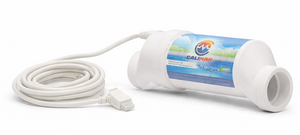
CaliMar and CompuPool build cells for other manufacturers' systems. Nobody in the documents read for this page measured one against the original, so we make no claim about output or life in either direction. What can be compared is on paper: the gallon rating, the warranty term where the product title prints one, what the title says is in the box, and who built it. Generic vs OEM salt cells sets that out system by system.
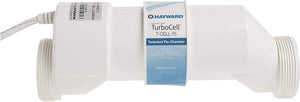
Hayward T-15. The original is the Hayward TurboCell T-15, titled for pools up to 40,000 gallons. CaliMar's cell for the T-Cell-15 prints 40K gallons and a 2-year warranty in its title. CompuPool's cell for the T-Cell-15 prints 40K gallons and a cord. Hayward's product page lists a 15 ft cell cord and 13 plates and has no row for unions, and its manuals do not say what comes with a replacement TurboCell. The T-Cell-15 page sets them side by side.
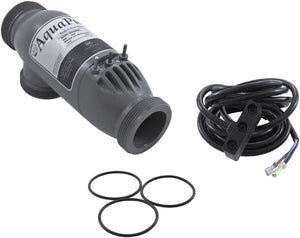
Jandy AquaPure 1400. Jandy's own is the 3 port, 14 blade cell kit R0452400, titled for 40,000 gallon pools. CompuPool's 3 port, 14 blade cell for the AquaPure prints 40,000 gallons too. Neither title prints a warranty.
Pentair IntelliChlor. Pentair's own 40,000 gallon cell is the IntelliChlor Plus40, the newer generation. CaliMar's cell for the IC40 is titled as compatible with the IC40 at 40K gallons. They are two different cells, so settle which one your system takes first.
Pentair's guides and Jandy's manuals do not mention cells from other manufacturers. Hayward's AquaRite owner's manual says a non-genuine cell on a Hayward control voids the warranty. AutoPilot's warranty is void where parts do not meet OEM specifications, and CompuPool's manuals say to use only cells labeled as a replacement for the model. If your control is under warranty, read it before you choose.
Products in this guide
Questions
How long does a salt cell last?
It depends on the manufacturer, and only some print a figure. Pentair gives the IntelliChlor IC and the iChlor about 10,000 hours, which it puts at roughly five years of average use. CompuPool gives the CPX cell 12,500 hours in normal use. Hayward times its Salt and Swim cells at 1,500 or 3,000 hours. Hayward prints no life for the TurboCell, and Jandy and AutoPilot print none for their cells, in the manuals we read. These are hours of making chlorine, so a cell on a long season reaches them sooner.
How do I know if my salt cell is bad?
Rule out everything else first. The cell is clean, the salt is right by a meter and not only by the display, the water is above the cut off for your system, and flow is good. If it still makes too little chlorine, read the system's own test. Hayward's guide replaces a TurboCell whose two salt readings, one for each polarity, differ by more than 500 ppm on a clean cell. Solaxx calls a PureChlor cell finished under 5.8 amps in Tech Mode. Jandy code 123 and AutoPilot LOW AMPS on a clean cell both print replacement.
Why is my salt cell not producing chlorine?
Usually for a reason that is not a dead cell. Scale on the plates, salt below the level your manufacturer sets, cold water, too little flow, or an output setting of zero all stop production. Hayward's AquaRite stops at 50F and Pentair's IntelliChlor at 52F, and a variable speed pump on low can fall under the flow the switch needs. Solaxx's bucket test separates a cell that is producing from water that is using the chlorine up. Only when those are cleared does the cell itself come into question.
Why does my salt system read low salt when the salt level is fine?
Because the display is the cell's estimate, not a measurement of the water. Hayward's troubleshooting guide says a dirty cell or an aging one reads lower than the real level, and that a low reading is always followed by cleaning the cell and then a meter test. If the water tests right, Hayward says never to add salt for it. Cold water does it too: CompuPool says a CPX can light Low Salt under 60F with nothing wrong, and Jandy lists cold water among the causes of Lo Temp/Lo Salt on a TruClear.
Does cold water stop a salt cell?
Yes, at a temperature each manufacturer sets. Hayward's AquaRite cuts output to 20% or lower at 60F and stops at 50F. Pentair's IntelliChlor and iChlor switch off at 52F, give or take 3F. Jandy's AquaPure manual prints two figures, 51F in one section and 54F for its Lo code. AutoPilot does not shut off: a Pool Pilot Digital holds output at 1% at 55F or colder. CompuPool stops a CPX below 45F. A cell that quits in cold water has not failed.
Does cleaning a salt cell make it last longer or shorter?
Both, depending on how often. AutoPilot says calcium build up left on the blades shortens the cell's life, so a scaled cell should be cleaned. AutoPilot also says unnecessary cleaning reduces cell life, and Pentair and Jandy both print that excessive acid washing damages the cell. CompuPool says excessive cleaning shortens a CPX cell's life. Clean when you can see scale, not on a calendar, and fix the water balance that caused it.
Do I have to change any settings when I fit a new salt cell?
On some systems. A Hayward AquaRite must be set to its cell, t-3, t-5, t-9 or t-15, and Hayward's guide says to reset the average salt after a replacement. An AutoPilot Pool Pilot needs its Cell Type matched to the cell and its amp hour count reset through the Replace Cell menu. A Solaxx PureChlor has to be reprogrammed for any new cell. CompuPool says a CPX needs no control changes for a replacement cell, and Pentair's IntelliChlor guides describe no cell type setting.