
Pool School, Salt Systems
Pool Salt Calculator: How Much Salt to Add
Active Pool Supply · Updated October 1, 2026
Pounds of salt to add = pool gallons x 8.345 x (target ppm minus current ppm), divided by 1,000,000. A 10,000 gallon pool with no salt needs 267 lb to reach Hayward's 3,200 ppm, 300 lb for Pentair's 3,600 and 250 lb for the 3,000 a Jandy AquaPure table aims at, the figures those manufacturers' manuals print. The target depends on who made the salt system, so take it from the manual or from the list in the calculator. Test first, because most pools already hold some salt. Pour it into the pool, never the skimmer, brush it in, run the pump 24 hours and test again.
Pool salt calculator
Pounds of salt are gallons x 8.345 x the rise in ppm, divided by 1,000,000. That is the arithmetic behind the manufacturers' own salt tables: 10,000 gallons from zero comes to 267 lb at Hayward's 3,200 ppm, 300 lb at Pentair's 3,600 and 250 lb at Jandy's 3,000, the figures their manuals print. Each system's level is the one its manufacturer's manual names, and you can type over it. Test the water before you add salt, and test again after the pump has run 24 hours. Gallons worked out from dimensions are an estimate.
How much salt to add to a pool
Pounds of salt = gallons x 8.345 x (the level you want minus the level you have, in ppm), divided by 1,000,000. A 10,000 gallon pool with no salt in it needs 267 lb to reach Hayward's 3,200 ppm, the figure on Hayward's chart.
The level you want depends on who made the salt system: Hayward asks for 3,200 ppm, Pentair for 3,600, Jandy for 3,000 on a TruClear and 4,000 on an AquaPure Ei. Pick your system in the calculator and enter the salt already in the water.
How the calculator works
Salt to add, in pounds = gallons x 8.345 x (target ppm minus current ppm) / 1,000,000
No manufacturer prints the 8.345. It is what their salt tables divide out to: 8.345 from Pentair's table, 8.34 from Hayward's and Solaxx's, 8.33 from Jandy's and AutoPilot's, which round to the pound. The division is ours. The formula lands on what they print:
| Whose salt table | Level it aims at | Printed, 10,000 gallons from zero | The formula |
|---|---|---|---|
| Hayward AquaRite | 3,200 ppm | 267 lb | 267 lb |
| Pentair IntelliChlor | 3,600 ppm | 300.43 lb | 300 lb |
| Jandy AquaPure and TruClear, AutoPilot Pool Pilot Digital | 3,000 ppm | 250 lb | 250 lb |
| Solaxx Reliant and PureChlor | 3,500 ppm | 292 lb | 292 lb |
Bigger pools can drift by a pound, because the manufacturers round: at 20,000 gallons the formula gives 534 lb where Hayward's chart prints 533. CompuPool's rounded start up rate, 0.03 lb a gallon, comes to 300 lb for 10,000 gallons where its own metric chart converts to 292.
Like the manufacturers' tables, the calculator starts from the salt already in the water. Without a gallon figure it estimates one: length x width x average depth x 7.5 for a rectangle, x 6.7 for an oval, and diameter x diameter x depth x 5.9 for a round pool.
For bags it divides the pounds by 40 and shows the whole bags on either side with the level each one reaches, so you can see whether the last bag is worth opening. Forty pounds is our choice, not a standard: Hayward's manual says salt is sold in 40 to 80 lb bags and AutoPilot's says 25 to 80.
Salt level by system
There is no one right salt level. Jandy asks for 4,000 to 4,500 ppm on an AquaPure Ei, yet on a Jandy AquaPure the manual warns of damage to the power center above 4,000, and Hayward's chart says to dilute from 3,600. Figures are ppm.
| System | Manufacturer's target or ideal | Warns, or output drops | Stops making chlorine | High salt, by the manufacturer |
|---|---|---|---|---|
| Hayward AquaRite, AquaRite 900, AquaTrol, Salt and Swim 3C | 3,200, ideal 2,700 to 3,400 | Below 2,700 | AquaRite: 2,300 or less (service guide), below 2,400 (owner's manual) | Shuts down, level not printed. Chart: dilute from 3,600 |
| Hayward AquaRite S3 | 3,200, runs 1,200 to 8,000 | 2,700, the factory alarm setting | Below 800 | Alarm at 3,400 as shipped. Shut off not printed |
| Pentair IntelliChlor IC | 3,600, good light 2,800 to 4,500 | Below 2,800 | Below 2,600 | Above 4,500: light flashes, corrosion warning |
| Pentair IntelliChlor Plus and LT | 3,600, range 2,600 to 4,500 | Below 3,000 | Below 2,600 | Above 4,500: warns, still produces. Above 6,000: faster corrosion |
| Pentair iChlor | 3,600, range 3,000 to 4,500 | Below 3,000 | Below 2,000 | Above 4,500: light flashes |
| Jandy AquaPure and PureLink | 3,000 to 3,500 | Below 2,000: code 144 | Below 2,000 | Above 4,000: code 145, may damage the power center. Above 6,000: corrosion |
| Jandy AquaPure Ei | 4,000, hold 4,000 to 4,500 | Below 3,000, light stays on until 3,500 | Not printed | Above 6,000: corrosion |
| Jandy TruClear | 3,000, hold 3,000 to 3,500 | Well below 2,500, warning stays on until 3,000 | Not printed | Corrosion above 6,000 on one page, 4,500 on another |
| Zodiac Nature2 Fusion Soft | 3,000 to 3,500 | Not printed | Not printed | Above 4,000: may damage the power center. Above 6,000: corrosion |
| AutoPilot Pool Pilot Digital and Soft Touch | 2,500 to 4,500, chart aims at 3,000 | 2,000 to 2,400 | Below 1,900 | No shut off. Above 6,000: corrosion |
| AutoPilot Nano | 3,500 to 4,500 in the table, 3,000 to 4,500 in the text | 2,300 or below | Below 1,900 | Above 6,000: not recommended |
| AutoPilot ChlorSync | 3,500 to 4,500 | 2,300 to 2,700 | Below 2,300 | Above 5,000: light flashes, still produces |
| CompuPool CPSC | 3,500 | Add Salt light, level not printed | Not printed | Over Salt light, still produces, level not printed |
| Solaxx Saltron Reliant | 3,500 | Not printed | Not printed | Above 5,500: corrosion |
| Solaxx PureChlor | 3,500 to 4,500 | Low Salt light, level not printed | Not printed | Not printed |
The bold figure is the one the calculator loads, and you can type over it. Where a manufacturer gives a band, it is the level that manufacturer's salt table or worked example aims at. On AutoPilot's Nano and ChlorSync and Solaxx's PureChlor, 3,500 ppm is also the bottom of the band.
For scale: Hayward says salt starts to be tasted at about 3,500 to 4,000 ppm, and AutoPilot says most people taste it above 3,500. NOAA puts seawater at about 35 parts per thousand, which is 35,000 ppm, and PHTA gives 31,000 to 38,000.
Pool salt chart: pounds from zero
For a pool with no salt in it, by the formula above, rounded to the pound.
| Pool size | 3,000 ppm: Jandy AquaPure, TruClear, Fusion Soft, AutoPilot Pool Pilot Digital | 3,200 ppm: Hayward | 3,500 ppm: CompuPool, Solaxx, AutoPilot Nano, ChlorSync | 3,600 ppm: Pentair |
|---|---|---|---|---|
| 10,000 gallons | 250 lb | 267 lb | 292 lb | 300 lb |
| 15,000 gallons | 376 lb | 401 lb | 438 lb | 451 lb |
| 20,000 gallons | 501 lb | 534 lb | 584 lb | 601 lb |
| 30,000 gallons | 751 lb | 801 lb | 876 lb | 901 lb |
| 40,000 gallons | 1,001 lb | 1,068 lb | 1,168 lb | 1,202 lb |
Jandy's AquaPure Ei, at 4,000 ppm, takes 334 lb for each 10,000 gallons, the figure Jandy prints. If the pool already holds salt, take the reading off first: a 15,000 gallon pool reading 2,400 ppm needs 100 lb to get back to Hayward's 3,200, not 401.
Test before you add salt
Most pools already hold some. Hayward's manual says long use of chlorine leaves salt behind, Jandy says it of liquid chlorine in particular, and Pentair's first step is to test. Starting from a chlorine pool? The rest of that job is in how to convert a pool to salt water.
A low reading on the unit is not always low salt. Hayward's service guide says a dirty or ageing cell can show a level well away from the true one, and sets the order: clean the cell, then measure with a meter, and add no salt until you have. Here is how to clean a salt cell, and Hayward's Digital Salt Water Tester is a meter for the second step.
Cold water reads low too: AutoPilot's Pool Pilot Digital names cold water and a scaled cell beside low salt as causes of its low conductivity warning. If a meter finds the salt and a clean cell still reads low, see when to replace a salt cell and the salt cells by system.
Which salt to use
Plain sodium chloride, as pure as you can find. Every manufacturer rules out rock salt, and each either forbids iodized salt or specifies non-iodized.
| Manufacturer | Purity | Water softener pellets | Anti-caking agents (yellow prussiate of soda) | Also ruled out |
|---|---|---|---|---|
| Hayward | Over 99 percent | Accepted, slower to dissolve | AquaRite: none. AquaTrol and AquaRite S3: 1 percent at most | Iodized salt |
| Pentair | 99.8 percent or better | Allowed, slower, could damage plaster | Avoid | Calcium chloride, potassium chloride. Plus and LT: sodium bromide |
| Jandy and Zodiac | 99.8 percent or better | Allowed, slower | Avoid: can discolor fittings and finishes | Calcium chloride |
| AutoPilot | Over 99 percent | Listed as a common type | Pool Pilot Digital: usable, may tint or stain unless dissolved at once. Nano and ChlorSync: not recommended | Salt with iodine or rust preventatives |
| CompuPool | 99.8 percent or better | Allowed, slower | Avoid | Calcium chloride |
| Solaxx | Not printed | Do not use | 1 percent at most | Iodized salt, calcium chloride |
Water softener salt is the real disagreement: five manufacturers allow the pellets with a caution, and Solaxx's Reliant manual lists water softener salts among what not to use.
How to add salt to a pool
- Test the water and work out the pounds. Jandy's TruClear manual says to err low: adding more is easier than diluting.
- Turn the pump on and leave it on.
- Set the cell by your manufacturer's rule. Pentair: IntelliChlor off before salt goes in, on again once the reading is confirmed. Jandy: production at 00 percent, because an AquaPure run above that with no salt damages its cell. CompuPool: off or in manual mode. AutoPilot's Soft Touch: output at 0 percent for the 24 hours. AutoPilot's Nano and ChlorSync may run straight away. Hayward and Solaxx do not say.
- Pour it into the pool, never the skimmer. Pentair, Jandy and Solaxx all rule the skimmer out. Pentair says the outer perimeter, Jandy the perimeter or the shallow end, CompuPool the shallow end. The main drain is where they split: Jandy says never add salt through it, and AutoPilot's Pool Pilot Digital manual says to put the salt over it. Hayward says add salt straight to the pool and draw the pump's suction from the main drain.
- Brush it. Salt water is heavier than fresh, Hayward's service guide explains, and settles at the deep end. Do not leave it in a pile.
- Run the pump 24 hours. Hayward, Pentair, Jandy and AutoPilot all give that figure. CompuPool allows 24 to 48 hours in summer, and more in winter, for salt to dissolve.
- Test again, then switch the cell on. The wait is 24 hours for Hayward's display, Pentair and Jandy's AquaPure, 6 to 8 hours on Hayward's Salt and Swim, and 48 to 72 hours on Jandy's TruClear.
New plaster waits. Hayward's AquaRite manual says 10 to 14 days before salt and its Salt and Swim manual 10 to 30. Pentair says at least a month. Jandy says 30 days for new or resurfaced concrete, and no wait for vinyl or fiberglass. AutoPilot's Nano and ChlorSync manuals say 30 days.
Too much salt
Salt comes out one way: water goes out and fresh water goes in. Hayward and AutoPilot each call a partial drain and refill the only way to lower it, and Pentair, Jandy and CompuPool give the same instruction. Solaxx's manuals give none.
The share of the water to replace is 1 minus (the level you want / the level you have). At 4,000 ppm, getting down to Hayward's 3,200 means 1 minus 3,200 / 4,000, which is 20 percent: 3,000 gallons of a 15,000 gallon pool. Enter a current level above the target and the calculator gives the percent and the gallons.
Hayward's service guide prints the same sum in inches and calls it the proportional method: average depth x 3,200, divided by the measured salt level, is the depth to keep. Its example is a pool 54 inches deep at 4,500 ppm: 54 x 3,200 / 4,500 is 38.4 inches to keep, so 15.6 go, which is 29 percent. Hayward advises dropping the pool six inches at most, refilling, and repeating.
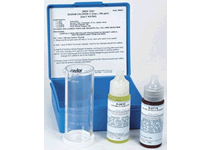
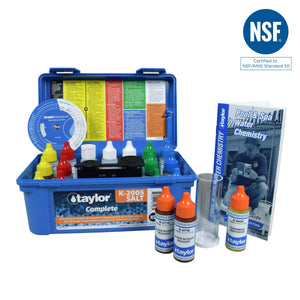
Jandy's TruClear manual says to confirm a high reading by the most reliable test available before diluting. AutoPilot notes that diluting lowers stabilizer too, so test it afterwards against your own manual's range, because the manufacturers' ranges differ. The Taylor K-2005-SALT kit tests both.
How often salt needs topping up
Seldom, and never because of evaporation. Salt stays behind when water evaporates: Hayward, AutoPilot and CompuPool all say so. It leaves with the water that leaves, by splash out, backwash, rain that overflows or is drained off, and leaks.
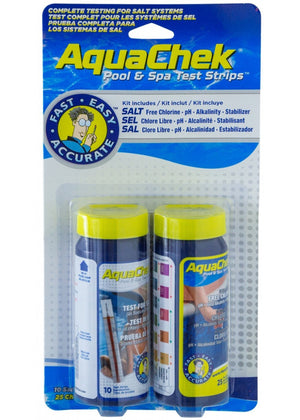
Test monthly. Hayward's AquaRite 900 manual puts salt on its monthly list, and so do Pentair, Jandy and AutoPilot's Pool Pilot Digital. The AquaChek Salt System Test Kit packs white salt strips with yellow 4-way strips for that monthly round.
A 15,000 gallon pool that has slipped from Hayward's 3,200 ppm to 2,600 needs 75 lb, two 40 lb bags.
How to measure salt, and how far readings disagree
Expect two tests to differ by a few hundred ppm. The manufacturers say so:
- Hayward's service guide expects an AquaRite to read within 500 ppm of an independent test.
- Pentair rates the IntelliChlor's sensor at plus or minus 500 ppm and the iChlor's at plus or minus 300.
- Jandy says salt test strips vary by 400 to 800 ppm, and names a meter calibrated for salt or a titration test to check a suspect sensor.
- AutoPilot says to recalibrate a Pool Pilot Digital that sits over 400 ppm from a good test.
One reading does not justify a bag of salt or a partial drain. Take two, by different methods.
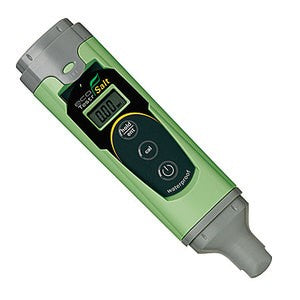
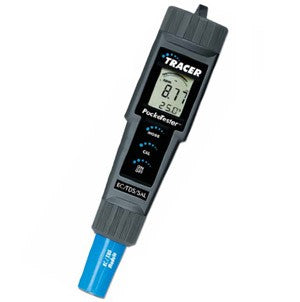
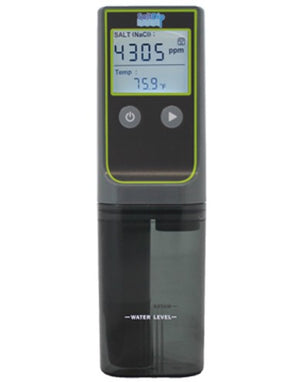
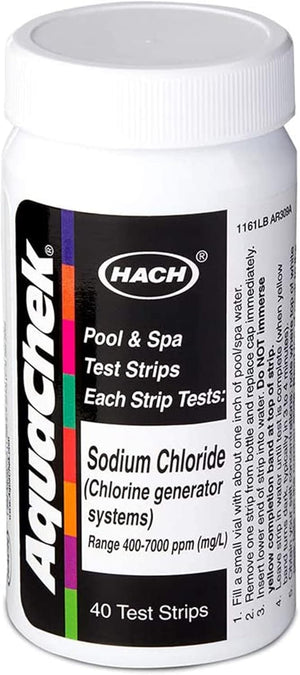
Strips are the quick check: AquaChek White Salt strips in a 10 strip bottle, or the 40 count bottle. Drops are the second opinion: Taylor's K-1766 salt water drop test kit. A meter is the third: the LaMotte Tracer shows salt, TDS and temperature, and the Solaxx SaltDip is an electronic salt tester. All of them are under water testing.
Some systems leave the measuring to you: Jandy's TruClear manual says the unit takes no salinity reading of its own and tells owners to use strips or a meter.
Products in this guide

Questions
How much salt do I need for a 15,000 gallon pool?
From no salt at all: 376 lb to reach the 3,000 ppm that Jandy's AquaPure and TruClear tables aim at, 401 lb for Hayward's 3,200 ppm, 438 lb for the 3,500 ppm CompuPool and Solaxx ask for, and 451 lb for Pentair's 3,600 ppm. The sum is gallons x 8.345 x ppm, divided by 1,000,000. Most pools already hold some salt, so test first and take that reading off the target. A pool reading 2,400 ppm needs only 100 lb to reach Hayward's level.
What should the salt level be in a salt water pool?
It depends on who made the salt system. Hayward gives 3,200 ppm as optimal inside 2,700 to 3,400. Pentair gives 3,600 ppm as ideal. Jandy asks for 3,000 to 3,500 ppm on an AquaPure, 3,000 on a TruClear and 4,000 on an AquaPure Ei. AutoPilot gives 2,500 to 4,500 ppm for the Pool Pilot Digital. CompuPool's CPSC and Solaxx's Reliant both ask for 3,500 ppm. PHTA puts generators between about 3,000 and 5,000 ppm and says the manufacturer's instructions decide.
How many bags of salt do I need for my pool?
Divide the pounds by the weight of the bag and round to a whole bag. For a 10,000 gallon pool with no salt in it, Hayward's 3,200 ppm takes 267 lb, which is seven 40 lb bags, and Pentair's 3,600 ppm takes 300 lb, which is eight. A 20,000 gallon pool takes 501 lb to reach the 3,000 ppm of a Jandy TruClear, so 13 bags. No manufacturer names a standard bag: Hayward's manual says 40 to 80 lb and AutoPilot's 25 to 80 lb. The calculator on this page counts 40 lb bags.
Can I use water softener salt in my pool?
On most systems, yes. Hayward, Pentair, Jandy, AutoPilot and CompuPool all accept water softener or water conditioning pellets, and say they take longer to dissolve. Pentair adds that pellets could damage plaster. Solaxx does not: its Reliant manual lists water softener salts with rock salt and iodized salt as salts not to use. Whatever you buy, it should be sodium chloride over 99 percent pure for Hayward and AutoPilot, and 99.8 percent or better for Pentair, Jandy and CompuPool.
Why does my salt system say low salt after I added salt?
Usually because the reading has not caught up. Hayward says its salt display is an average and can take 24 hours to respond. Pentair says to read salinity only after the pump has run 24 hours, and Jandy's TruClear manual says to verify after 48 to 72 hours. If it still reads low, do not add more yet. Hayward's service guide says a dirty or ageing cell reads low when the salt is there: clean the cell, then check the water with a meter.
Does salt evaporate from a pool?
No. Hayward, AutoPilot and CompuPool all state that salt is not lost when water evaporates. It leaves with water that leaves the pool: splash out, backwashing, rain that overflows or is drained off, and leaks. That is why a salt pool needs a top up now and then, not a fresh dose each season, and why a level that keeps dropping with no rain or backwash points at a leak.
What happens if I put too much salt in my pool?
It depends on the system. A Hayward AquaRite shuts down on high salt, at a level its manual does not print. Pentair's IntelliChlor warns above 4,500 ppm. Jandy's AquaPure throws code 145 above 4,000 ppm and the manual says the power center may be damaged. AutoPilot's Pool Pilot has no high salt shut off. For corrosion, Pentair warns above 4,500 ppm, Solaxx above 5,500, Jandy and AutoPilot above 6,000. The fix is the same for all: replace part of the water. The share is 1 minus the target divided by the current level.