
Pool School, Closing
How Many Water Tubes Do You Need for a Pool Cover?
Active Pool Supply · Updated September 22, 2026
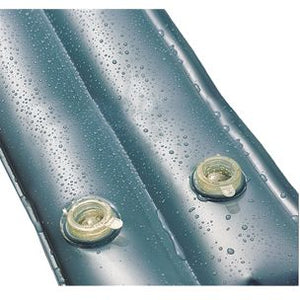
Count the edge of the cover, not the edge of the pool. A solid inground winter cover is cut to the pool plus 5 feet, so a 20 x 40 ft pool takes a 25 x 45 ft cover with a 140 ft edge, which is 18 tubes of 8 ft or 14 of 10 ft laid end to end. Fill each one about two-thirds to three-quarters full, never completely, so the ice has somewhere to go. Water tubes hold a solid cover down. They are not a safety device, and bricks and blocks must never be used instead.
The rule in one line
Lay tubes end to end all the way around the edge of the cover, and count how many that takes.
That last word is where most charts differ from this one. A solid inground winter cover is cut to your pool size plus 5 feet, which puts 2.5 feet of it on the deck on every side. The tubes sit on that overhang, not on the water, so the run they have to weight is the cover's edge and not the pool's. On a 20 x 40 ft pool that is 140 feet rather than 120, and the extra 20 feet is about three more tubes.
Water tubes by pool size
Every size here is one of our cover pages, so the link goes straight to the covers cut for that pool.
| Pool size | Cover size | Run to weight | 1 x 8 ft tubes | 1 x 10 ft tubes |
|---|---|---|---|---|
| 12 x 20 ft | 17 x 25 ft | 84 ft | 11 | 9 |
| 12 x 24 ft | 17 x 29 ft | 92 ft | 12 | 10 |
| 14 x 28 ft | 19 x 33 ft | 104 ft | 13 | 11 |
| 16 x 24 ft | 21 x 29 ft | 100 ft | 13 | 10 |
| 16 x 32 ft | 21 x 37 ft | 116 ft | 15 | 12 |
| 16 x 36 ft | 21 x 41 ft | 124 ft | 16 | 13 |
| 16 x 38 ft | 21 x 43 ft | 128 ft | 16 | 13 |
| 16 x 40 ft | 21 x 45 ft | 132 ft | 17 | 14 |
| 18 x 36 ft | 23 x 41 ft | 128 ft | 16 | 13 |
| 18 x 40 ft | 23 x 45 ft | 136 ft | 17 | 14 |
| 20 x 40 ft | 25 x 45 ft | 140 ft | 18 | 14 |
| 20 x 44 ft | 25 x 49 ft | 148 ft | 19 | 15 |
| 20 x 45 ft | 25 x 50 ft | 150 ft | 19 | 15 |
| 24 x 40 ft | 29 x 45 ft | 148 ft | 19 | 15 |
| 25 x 40 ft | 30 x 45 ft | 150 ft | 19 | 15 |
| 25 x 45 ft | 30 x 50 ft | 160 ft | 20 | 16 |
| 25 x 50 ft | 30 x 55 ft | 170 ft | 22 | 17 |
| 30 x 50 ft | 35 x 55 ft | 180 ft | 23 | 18 |
| 30 x 55 ft | 35 x 60 ft | 190 ft | 24 | 19 |
| 30 x 60 ft | 35 x 65 ft | 200 ft | 25 | 20 |
Add four corner tubes if you want them, and a pair of 4 ft tubes if the pool has steps. Neither is counted above.
Which length, and single or double
We stock 8 ft tubes and 10 ft tubes. Neither is better; pick whichever divides your sides with less waste. A 30 ft side takes three 10 footers cleanly where it would need four 8 footers with 2 feet spare.
Single chamber tubes are one long sleeve. Double chamber tubes are two sleeves side by side sharing a seam, so a split in one half does not empty the whole tube and the tube is harder to roll off the cover. Double is the usual choice for an inground pool.
Gauge is the vinyl thickness. 16 gauge is heavier than 20 and lasts longer in sun and ice.
Filling them
Put each tube in place on the cover first, then fill it. A filled tube is heavy and awkward, and dragging one across a cover is how covers tear.
Fill to about two-thirds or three-quarters, and never completely. Water expands roughly nine percent when it freezes, and a tube filled to the cap has nowhere to put it. Sources range from half full to eighty-five percent; two-thirds to three-quarters sits comfortably inside all of them. Point the caps upward.
A splash of non-toxic pool antifreeze in each tube guards against the split, if you want the extra margin.
Placing them
Set the tubes back from the water's edge, about 18 inches, rather than right on the lip. Thread each one through the cover's hand loops so the cover cannot slide out from under it. Lay them end to end with no gaps; if you are short and have to space them, leave no more than a foot between tubes, and go end to end in a windy yard whatever the count says.
What water tubes are not
They are not a safety device. A solid cover with water tubes on it holds neither a child nor a pet, and it is not designed to. A safety cover is a different product that anchors into the deck.
Never substitute bricks, blocks, stones or anything else heavy. They tear the cover where they rest, and they end up in the pool alongside whoever went through.
Products in this guide



Questions
How many water tubes for a 20 x 40 pool?
Eighteen 8 ft tubes, or fourteen 10 ft tubes. A 20 x 40 ft pool takes a 25 x 45 ft cover, whose edge runs 140 ft, and the tubes lie along that edge end to end.
Why does your chart say more tubes than the one I saw elsewhere?
Because we count the cover's edge and most charts count the pool's. A solid cover is 5 ft bigger than the pool, which adds 20 ft of edge, which is about 3 more tubes on any size. The tube sits on top of the cover, out on the deck, so the cover's edge is the line it actually has to run along. A chart built on the pool perimeter leaves roughly a fifth of that edge unweighted.
How full should water tubes be?
About two-thirds to three-quarters. Never completely full. Water expands as it freezes, and a tube with no headspace splits. Fill them after they are in place on the cover, not before, and point the caps upward.
Do I need corner tubes?
They are worth having and they are not mandatory. A straight tube does not sit in a corner, and corners are where the wind gets under a cover. Corner tubes are L shaped, usually 2 ft by 2 ft. Short 4 ft tubes do the same job around steps.
Can I use bricks or concrete blocks instead?
No. They fail two ways. They tear the cover where they sit, and if someone falls in, they go into the pool too. Every source that covers this says the same thing.
Do I need water tubes with a safety cover?
No. A mesh or solid safety cover anchors into the deck with straps and springs and holds itself down. Water tubes are for a solid winter cover that simply lies on the water.