
Jandy
Jandy 1-1/2 in. x 2 in. Neverlube Positive Seal 3-Port Diverter Valve, 4715MPN 4715
$7199
In stock

New customer? Create an account
Sign in to track an order, view past orders, start a return, and save the equipment you own so every part you see already fits it.
Three jobs and three shapes. A ball or shutoff valve opens and closes one line, so a pump or a filter can be isolated without draining the pool. A three way diverter splits or blends flow between two paths, which is how a pad sends water to a spa, a cleaner line or a solar loop. A check valve lets water pass one way and shuts if it tries to come back, which is what keeps a pump primed and stops a heater draining into the pool.


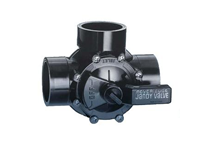


Diverters, ball valves, compression ball valves, check valves and multiport bodies from Pentair, Hayward, Jandy, Zodiac, Spears, CMP and Dura Plastics, in 1-1/2 in. up to 3 in., slip and threaded, in PVC and CPVC, with pressure ratings from 50 psi on the low pressure bodies up to 225.
Rebuild kits, diverters, seals and covers are in valve parts. Electric actuators that turn a diverter for you are automation, in automation parts and boards.
PVC or CPVC?
CPVC where the water is hot, PVC everywhere else, and the difference is temperature rather than pressure. Standard PVC softens well below the temperature a gas heater can produce at its outlet, which is why the run immediately downstream of a heater is the one place a pool pad routinely uses CPVC. Our valve shelf is roughly an even split between the two. If you are replacing a valve and the old one is CPVC, replace it with CPVC: somebody chose it for a reason and it was probably the heater.
Which way round does a check valve go?
Arrow pointing the way you want water to travel, and it is worth checking twice because a backwards one blocks the line completely. The two places they earn their keep are ahead of the pump on a pad that sits above the water, where a check valve holds the prime so the pump does not have to pull the column up again every start, and after a heater or a chlorinator, where it stops treated or hot water drifting back the wrong way when everything stops.
Why does my diverter leak around the handle?
Almost always the stem seal rather than the valve, and it is the cheapest fix on the pad. The shaft the handle turns passes through an o-ring, and that ring dries, flattens and eventually weeps, usually first as a drip you only notice when the pump is running. On most pool valves the cover comes off from the top and the diverter and its seals lift straight out with the pipework untouched. Replace the valve body when the body itself is cracked or a port has failed, not for a weeping stem.
Does a valve restrict the flow?
All of them do a little and some do a great deal, which is why the type matters as much as the size. A full port ball valve at the same size as the pipe is close to a straight run when it is open. A diverter always turns the water through an angle, so it costs more, and a check valve costs something permanently because a spring or a flap sits in the path. Put as few as the job needs on the suction side in particular, because restriction there is what starves a pump.